
Almost every pianist who has been playing for a few years has had the same bad afternoon. Someone puts a piece of music in front of you, expecting the fluent player they have heard before, and what comes out is halting, wrong-handed and three times too slow. You can play. You just cannot read.
This guide is about closing that gap. It covers why the piano is genuinely the hardest instrument to read on, why sight-reading practice is so much harder to keep up than ordinary practice, what the research says actually works, and a concrete plan you can start this week whatever level you are at.
Why the piano is the hardest instrument to read on
The piano has a strong claim to being the most difficult instrument to sight read. Alongside the normal challenge of reading music at all, you have two clefs to learn rather than one, and two hands that are frequently asked to move very differently from one another at the same moment. Chords can grow as large as ten notes. The range is enormous: 88 keys at standard size, which means ledger lines and clef changes are a regular fact of life rather than an occasional curiosity. Even among polyphonic instruments the piano is unusually flexible, which opens the door to things like polyrhythms that most other instruments simply cannot produce on their own.
A flute player reads a line. A pianist reads a score.
That toughness comes with a reward, though. The piano is so versatile and so widely written for that learning to read its music well opens up an enormous amount of repertoire, from Bach to film scores to whatever a friend happens to leave on the music stand. You will also pick up a great deal of theory along the way, because reading fluently means recognising keys, chords and cadences on sight rather than spelling them out note by note.
If you want the longer version of why this skill is so stubborn, including the ways modern learning habits quietly make it worse, we wrote about it separately: why is piano sight reading so hard?
Sight reading is a different skill from playing
This is the single most important idea in the guide, and it is worth being blunt about it.
Learning a piece is like memorising a speech. You go over one passage until it is in your fingers, then the next, then you join them up. Sight reading is like reading aloud from a page you have never seen: you parse unfamiliar material in real time and keep talking, accepting that a few words will come out wrong.
The two skills use your attention completely differently, and they are trained differently. This is why so many competent players are poor readers. Years of learning pieces builds the first skill and barely touches the second. Worse, it actively trains the reflex that ruins sight reading: every time you stop and fix a wrong note, you rehearse stopping.
So if you only ever learn pieces, your reading will not catch up by osmosis. It has to be practised on purpose.
The three things that make sight-reading practice hard
Knowing what to practise is the easy half. Most people who fail at this fail for reasons that have nothing to do with technique.
Repertoire runs out. As soon as you begin to memorise a piece, it starts to lose its value as sight-reading material. That has two consequences. Learning pieces does not supply enough reading practice on its own, and finding a steady stream of new material at the right level becomes a chore in itself. It does get easier at higher levels, where you can read pieces a few steps below your playing level and there is a lot of music down there. Earlier on, you generally need material written specifically for sight-reading practice, and there is only so much of it in any one book.
Marking your own work is a skill of its own. Knowing whether you read something correctly is genuinely hard, especially early on. It is easy to miss a wrong note you played confidently, and harder still to be sure your rhythm was right rather than merely plausible. A teacher solves this, but not everyone can afford one, and even with weekly lessons most of your progress has to come from the practice in between.
It is not much fun. The biggest payoff in learning an instrument is usually playing something you enjoy, well. Sight-reading practice deliberately lives in the least satisfying part of that arc: the first contact, before any of the muscle memory is in place, when everything sounds worse than you would like. Nothing about it is rewarding in the moment, which is why it is the first thing to fall out of a practice routine.
Any approach that ignores these three is a plan for a fortnight, not a habit.
What actually works
The good news is that the technique is settled and unglamorous. Five rules cover nearly all of it. There is more detail, and the cognitive science behind it, in our companion piece on how to improve piano sight reading.
1. Read at 70 to 80 percent accuracy. That is the band where learning happens. Get more than about a quarter of the notes wrong and you are mostly practising panic, and rehearsing the wrong notes alongside the right ones. Get everything right and nothing is being stretched. In practice this means reading one or two grades below the pieces you are learning in lessons, which will feel disappointingly easy. Do it anyway.
2. Little and often. Studies of skill acquisition agree on this one: short bursts of ten to fifteen minutes a day will move you faster than an intensive weekly session of an hour or more. Skills consolidate between sessions rather than during them, mostly while you sleep, so six short sessions across a week give your brain six chances to file the patterns away and one long session gives it one. And if ten minutes is more than you can find, five still has real value. The number that matters is how many days you turn up, not how many minutes you log.
3. Never stop. Sight reading is performance mode, always. Wrong note, dropped beat, botched page turn: keep going and arrive at the final bar in time. Then look back. The looking back is useful, but it has to come after, not during. This is uncomfortable for the first week or two if you have spent years in rehearsal mode, and the discomfort is the point.
4. Read in chunks, and look ahead. Fluent readers do not see C, then E, then G. They see a C major triad in root position, and a hand shape to go with it. Five semiquavers register as a scalic run, not five separate events. You build that vocabulary of shapes through varied exposure, which is another way of saying that reading two hundred different pieces badly teaches you more than reading five pieces well. Once chunks start registering, your eyes are free to run a bar ahead of your hands, which is where the real fluency comes from.
5. Scan first, then count out loud. Before the first beat, check the key signature, the time signature, the starting note, and the highest and lowest notes. Then count aloud as you play. Counting out loud feels silly and works anyway: the voice holds the pulse while your eyes do the difficult work, and it is the cheapest available fix for the most common sight-reading failure, which is rhythm rather than pitch.
Where to start, by level
The rules above are the same at every level. What changes is the material.
You have never read music before. Start with the notes themselves rather than with pieces, and go in a straight line. Our Lessons path begins with one note on one line and no jargon, explaining one idea at a time and then giving you a short piece that uses it. If you would rather read about the fundamentals first, we have a plain-English primer on learning to read sheet music.
You can play a bit but reading is the weak link. This is the most common position, and the most fixable. Pitch your reading material below your playing level, read something new every day, and give it a few weeks before you judge progress. Adult learners in particular should read our notes on sight-reading exercises for adult beginners.
You are working through graded exams. The sight-reading test is the most predictable part of any piano exam, because the boards publish their constraints. We have a guide for each level, covering what ABRSM, Trinity, LCM, RCM, MTAC and AMEB expect, and what to practise: Initial Grade, Grade 1, Grade 2, Grade 3, Grade 4, Grade 5, Grade 6, Grade 7 and Grade 8.
You are teaching someone else. Children need the same practice shape with different framing, and a much shorter session. Our guide on teaching a child to sight read covers that, and teachers setting work between lessons may find how to set sight-reading homework useful.
If you are not sure which level you are reading at, SightReader’s grades map difficulty onto ABRSM Grades 1 to 8, so you can pitch your reading a step or two below where your lessons are.
How to tell whether you got it right
This is the problem that a metronome and a pile of sheet music cannot solve for you, and it is worth treating separately.
There are three things you need to know after a read-through, and only the first is easy to judge unaided. Did you play the right notes? Did you play them at the right time? And which specific things do you keep getting wrong?
The right notes you can mostly check by ear, slowly, after the fact. Timing is much harder, because a rhythm that is consistently wrong feels perfectly convincing from the inside. The third question is the one that actually decides how fast you improve, and almost nobody can answer it from memory. Most people have two or three specific weaknesses, such as the left hand below the stave, anything with a dotted rhythm, or one key signature they never quite internalised. Find them and your practice gets dramatically more efficient.
Three ways to get that feedback:
- A teacher. Still the best option, and worth it if you can. Even a lesson a month helps, so long as you practise in between.
- Record yourself. Play the piece once, without stopping, on your phone’s voice recorder. Then listen with the score in front of you. It is slow and mildly unpleasant, and it works.
- Let software mark it. With a MIDI keyboard, software can tell you exactly which notes you played and exactly when, and can keep a record across sessions so the patterns show up. That is what we built SightReader to do.
A plan for your first month
Concretely, if you want somewhere to start:
Week one. Ten minutes a day, or five if ten is a stretch. Pick material a grade or two below your playing level. One read-through of something new each day, metronome on, slower than feels necessary, no stopping. Do not judge the results yet.
Weeks two and three. Same ten minutes, but add the scan: key signature, time signature, starting note, highest and lowest notes, before the first beat. Start counting out loud. Expect the counting to fall apart the first few times.
Week four. Same again, and now look back. Which two or three things keep going wrong? Rhythms, one hand, one key, ledger lines? Spend one session a week on that specific thing and keep the rest of the week on fresh material.
After that. Keep going, and move the difficulty up only when you are consistently above about 80 percent. The habit is the whole game. Every pianist you envy at sight reading got there by reading a great many different things, briefly, often, and without stopping.
If you want the honest answer on timelines, we have written that up too: how long it takes to learn piano sight reading.
Why SightReader?
You do not need a tool to master sight reading. Generations of pianists got there with a teacher, a metronome and a stack of borrowed music. But we think a tool helps a great deal, because it attacks all three of the problems above directly, and we built SightReader to do exactly that.
1. Repertoire without thinking about it. Between Lessons, a library of over 3,700 pieces spanning four centuries, and an endless supply of generated scale and note drills, finding new material stops being your problem. Daily practice goes further and picks five pieces for you each day, so that even choosing is taken off the table and you can spend your ten minutes on the thing that matters, which is reading. You can also bring your own scores: exporting MusicXML from MuseScore covers how.
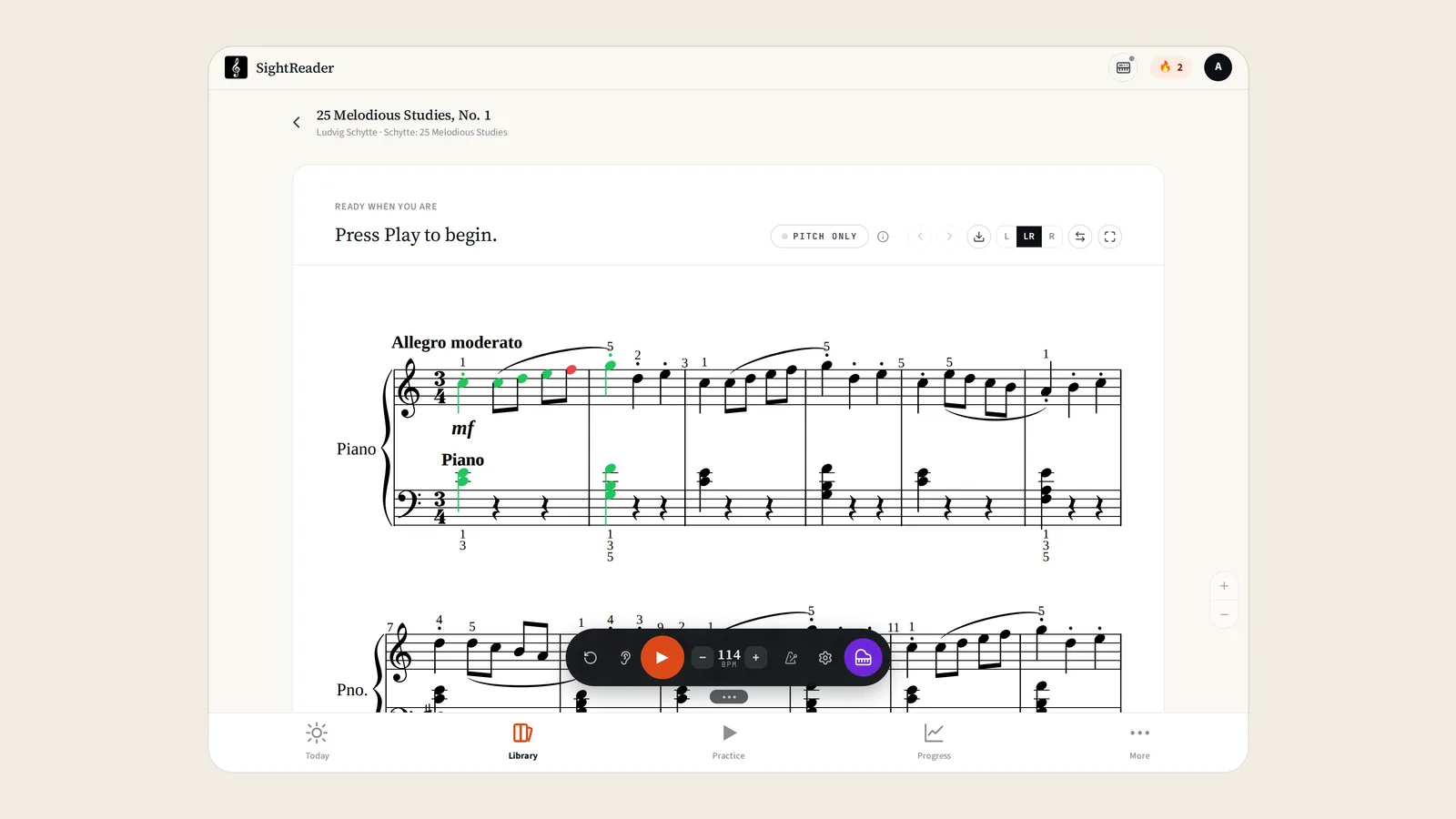
2. Live feedback, no teacher over your shoulder. Connect a MIDI keyboard and we mark every note as you play it. Notes you get turn green, misses turn red, and the cursor moves on whether or not you played the right thing, because stopping is the habit we are trying to break. In Pitch & Rhythm mode you also get the timing of every note: early ones shade blue, late ones yellow. Your progress page keeps the history, so the two or three things you keep getting wrong become visible rather than vague. The detail on the timing side is in our post on pitch and rhythm modes.
3. It is more fun. We borrow shamelessly from games here: stars, levels, streaks and badges to work towards. Sight-reading practice has no natural reward in the moment, so it needs a borrowed one, and that borrowed one is what decides whether you are still doing this in March.
There are other tools out there, and we think there was a real gap. Some are good for absolute beginners, focusing on note recognition, but they run out of usefulness quickly for anyone more advanced. Others are aimed at general piano learning, with sight reading as one feature among many. We are laser-focused on sight reading, from a single note on a single line all the way to Grade 8.
The free tier is genuinely usable: the whole of Foundation and Initial in Lessons plus the first unit of Grade 1, the first five levels of every grade from Initial to Grade 5, 54 pieces in the library, and unlimited note and scale drills. Pro is £5 a month and opens the rest. You need a browser and, ideally, a MIDI keyboard. There is nothing to install, and the on-screen keyboard works if you just want to try it.
FAQ
What is piano sight reading?
Sight reading is playing a piece you have never seen before, at sight, without stopping to work it out first. It is a separate skill from learning a piece. Learning is about getting one piece into your fingers and your memory; sight reading is about parsing unfamiliar music in real time, well enough to keep going.
How long does it take to learn to sight read piano music?
Ten minutes a day for about six months is enough to make a noticeable difference at most levels. A year of consistent daily practice will usually take you from freezing in front of unfamiliar music to comfortably reading a grade or two below your playing level. The daily part matters far more than the total hours.
What level should I sight read at?
One or two grades below the pieces you are learning in lessons. The band where learning happens is roughly 70 to 80 percent of the notes correct. Above that, the material is too easy to stretch you. Below it, you are mostly practising panic, and the wrong notes get as much rehearsal as the right ones.
Should I stop and correct my mistakes?
Generally, no. It is better to keep going and arrive at the final bar in time, then look back at what went wrong afterwards. Sight reading is closer to performance than to rehearsal, and stopping to fix things mid-piece quietly trains the habit that makes sight reading fall apart. Correcting mistakes is the right instinct when you are learning a piece, just not while you are reading one.
Do I need a MIDI keyboard?
No, but it helps. A MIDI keyboard is what lets software tell you which notes you actually played and how you timed them, which is the one thing that is genuinely hard to judge for yourself. An acoustic piano and a pile of unfamiliar music will still build the skill, as long as you are honest with yourself about the mistakes.
Can adults learn to sight read?
Yes, and often faster than children at sight reading specifically, because the bottleneck is pattern recognition rather than physical development, and adults can design their own practice. What adults usually lack is not aptitude but a steady supply of new music at the right level, and the patience to read it badly for a few weeks.