
The best sight reading exercises for adult beginners are short, daily, and deliberately too easy: spend ten to fifteen minutes reading new music a grade or two below what you can already play, and try to avoid the temptation to stop and fix your mistakes. The exercises themselves should be (relatively) simple. For many adult learners, the hardest part is letting yourself be a beginner again.
If you’re a complete beginner, start with note recognition and then the Initial Grade exercises. If you’re ready for some simple pieces with both hands, check out our Schäfer collection.
Learning as an adult is a different game
When you learn something as a child, the playing field feels level. You and your friends meet a new skill at roughly the same time, a bit of extra effort buys you an edge, and the grown-ups around you are impressed by almost any progress at all.
As an adult, sadly it feels very different. It’s easy to fall into a comparison trap, measuring your week-three playing against someone who happens to be younger than you and has fifteen years on the instrument. People are less impressed by improvement, too: with music, they mostly just decide whether they like the sound. On top of that, because you’re probably very good at something else by now, being bad at a new thing is genuinely uncomfortable. You’re used to knowing what you’re doing, and swapping that for not having a clue can feel unpleasant.
I’ve picked up two hard skills as an adult that I didn’t have as a child: coding and piano. I’d call myself an advanced coder now and an intermediate, improving pianist, and building SightReader has been part of that second journey. What got me started on both was, honestly, a rough patch. Coding was my way out of a job I didn’t enjoy. Piano became an emotional outlet after a bad break-up. But hard circumstances helped get me across the starting line. But what kept me going was fun: with code, building things I actually wanted to exist; with piano, learning pieces that moved me.
However, there was a catch. My piano playing got a lot better, while my sight reading ability barely budged. I could sit down with a piece I loved, work at it slowly until my fingers knew it, and never really read a note in the process (except for once or twice at the beginning, until I had stored the note in memory). That gap between “can play” and “can read” is the most common thing I see in adult learners, and closing it is exactly what sight reading exercises are for.
Why adults plateau at reading
If you only ever practise pieces you want to perform, you train your fingers and your memory, not your eyes. I’ve written more on why sight reading is so hard, but the short version is that reading is a separate skill from playing, and it’s the one that quietly gets skipped because it’s less fun and the payoff arrives later.
The fix is a small daily dose of the right kind of practice, kept easy enough that you’ll come back tomorrow. Adults tend to sabotage this by choosing material that’s too hard, because reading Grade 1 music when you can play Grade 4 pieces feels insulting! Leaning into that feeling will set you back. Reading fluency is built on music that, in the early days, is almost boring.
Five sight reading tips for adult beginners
Try these for ten to fifteen minutes a day, or five on the days you can’t find ten. The daily part matters more than the length; short sessions across many days beat one long weekend cram, which is the spacing effect at work.
- Read a grade below your playing level. If you can play Grade 3 pieces, read Grade 1 material. The goal is to read without stalling, and you can only do that on music that leaves you room to think.
- Scan for thirty seconds before you play. Check the key signature, the time signature, and the shape of the line: where it climbs, where it leaps, where it repeats. Most beginners skip this and pay for it in the first bar.
- Anchor on landmark notes. Rather than counting up from Middle C every time, memorise a few fixed points (Middle C, the F below it in the bass clef, the G above it in the treble) and read everything else as a distance from them. Reading intervals, the gaps between notes, is far quicker than naming each note in turn.
- Keep going, whatever happens. This is the exercise adults find hardest, because we often hate leaving a mistake behind us. Set a slow, steady pulse and don’t stop, don’t go back, don’t fix. A wrong note played in time is a win. Sight reading is the skill of carrying on.
- Use new music every single day. The moment a piece becomes familiar it stops training your reading. Tomorrow’s session has to be something your eyes haven’t seen before.
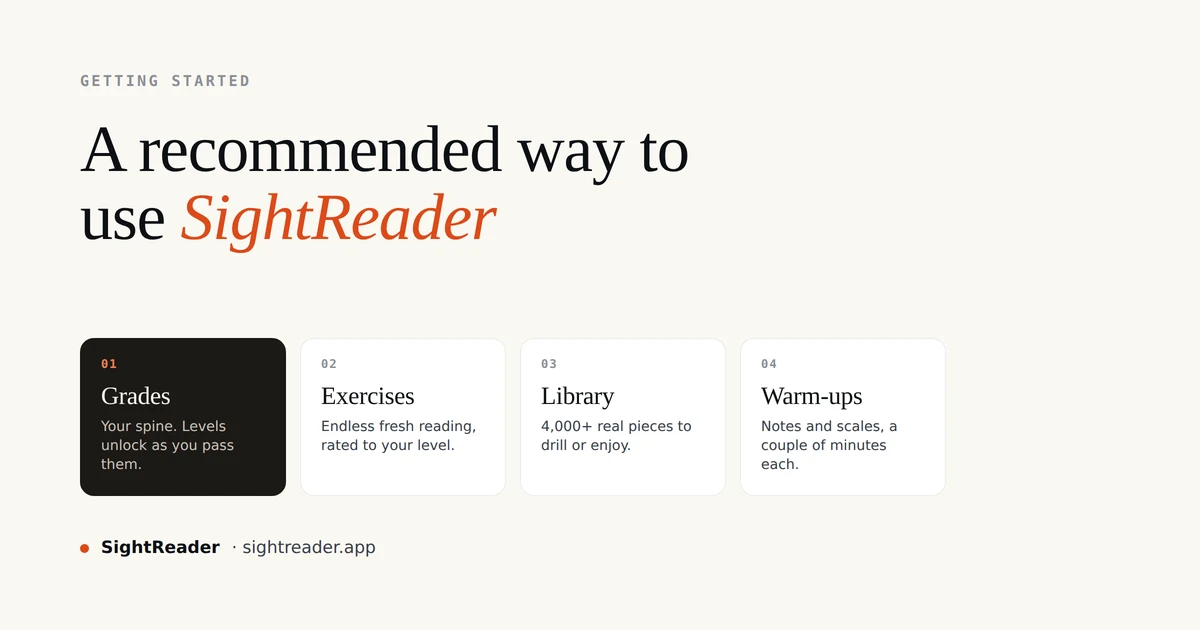
For material, method books like Schäfer or Schytte gradually ramp in difficulty. Another approach is working through the material from Grades. If hunting down fresh easy music every day sounds like exactly the friction that’ll make you quit, our daily practice offers new, level-appropriate suggestions each day, so you just sit down and read. To drill the raw note-recognition underneath all of this, the notes trainer isolates that one skill.
How long until it works?
Give it a couple of months of near-daily ten-minute sessions and you’ll notice new music stops frightening you. I’ve put concrete timelines in how long it takes to learn piano sight reading, and a fuller method in how to improve piano sight reading. The honest headline is that it’s slow but reliable: I’ve yet to meet anyone who read new music daily and didn’t get better at it.
If you’re heading towards exams, this matters more than most people realise. In ABRSM practical exams, sight reading is worth 21 of the 150 marks available, the same weight as scales, and it’s the section you can’t cram the week before (ABRSM). Ten minutes a day banks those marks quietly over months.
Where SightReader fits
We built SightReader because the tool I wanted didn’t exist: something that would put a fresh piece in front of me, watch what I played on my keyboard, and tell me honestly which notes I read right and which I fudged. As you play, it marks each note in real time — and with the metronome on, whether you were early or late as well — so you can’t kid yourself that a learned-by-ear approximation counts as reading. A session ends with a star rating and a streak, which sounds trivial until you notice it’s the thing getting you back to the bench on day nine.
It won’t remove the discomfort of being a beginner again. Nothing will, and I’d distrust anything that promised to. What it does is take the admin out of the way, with no hunting for new music and no guessing whether you got it right, and leave you with just the ten minutes that actually build the skill.
If there’s something that would make practice click for you, email us at [email protected]. We read every message.
FAQ
What are the best sight reading exercises for an adult beginner?
Ten to fifteen minutes a day of reading new music a grade or two below your playing level, scanning the key and time signature before you start, anchoring on a few landmark notes and reading the gaps between them, and not stopping to fix a wrong note. The exercises are simple. The discipline of keeping them easy and daily is the hard part.
I can play pieces well but I can’t read music. Why?
Because playing a piece you’ve learned and reading a new one are different skills, and most people spend much longer practising the first. When you learn a piece slowly until your fingers know it, you’re training memory and muscle, not reading. The fix is to spend a few minutes a day on unfamiliar, easier music that your fingers can’t already play from memory.
Am I too old to learn to sight read?
No! Reading is pattern recognition, and adults are good at patterns. The thing that slows adults down isn’t age, it’s impatience: we pick music that’s too hard because reading beginner material feels beneath us. Start easier than feels dignified and progress is steady at any age.
How much should I practise sight reading each day?
Ten to fifteen minutes is the sweet spot, and even five minutes has real value if that’s all you can find. Doing it most days matters far more than the length of any single session: short, spaced practice consolidates a skill better than an occasional long cram. If you’re preparing for an exam with a deadline, slightly longer sessions can make sense, but daily-and-short still wins.
Should I learn note names or read by intervals?
Both, but lean on intervals once you know a handful of landmark notes. Naming every note from scratch is slow. If you can instantly find Middle C, the F below it in the bass clef and the G above it in the treble, you can read everything else as a distance up or down from those anchors, which is how fast readers actually do it.
Do I need a real piano or a MIDI keyboard?
You can practise reading on any keyboard, or even away from one. A MIDI keyboard helps if you want a tool to check your reading for you, because the software can see exactly which notes you played and mark them right or wrong. Without one, you’re grading yourself, which is harder to do, especially if you’re earlier in your music reading journey.