
Ofsted’s 2023 music report says that pupils need to decode notation automatically, not just know what the symbols mean, and that most schools aren’t getting them there. Automatic decoding comes from short, frequent, marked reading of new music, which a single unit on notation, or one lesson a week, can introduce but can’t supply on its own.
That second sentence is the whole argument of this post. The rest is what I think it means in practice for a department that has the time it has.
What the report actually found
Striking the right note was published in September 2023 and draws on inspection visits to 50 schools, half primary and half secondary. It follows Ofsted’s 2021 music research review, which set out what high-quality music education looks like. If you lead a department you’ve probably read both. The findings on notation are worth pulling together, because they’re spread across the report:
- Notation was taught well in only a few schools. In others, staff notation was typically introduced in a single unit, and in some, pupils met notation with no expectation that they would learn to use it.
- Where it worked, it was sequenced. In the schools that taught it well, leaders had designed the curriculum so that knowledge of notation was introduced step by step.
- Secondary pupils had gaps even when they did well at GCSE. Those gaps were usually in knowledge of how music works: keys, chords, scales and notation.
- Key stage 3 time varied a great deal, and in just over half of the schools visited, leaders had given music limited time.
- Many teachers, particularly in primary, said they lacked confidence teaching music, including demonstrating what good work looks like.
And the line I keep coming back to: “Being able to decode the notation automatically, however, is central to pupils being able to use the system musically.”
Knowing notation is not the same as reading it
Most pupils who’ve done a notation unit can tell you that a minim is two beats and that the note on the bottom line of the treble stave is E. Give them time and they’ll work out a bar. That’s knowledge, and it’s worth having.
Automatic decoding is a different thing. It’s the point where a pupil sees the note and plays it, without the small pause in which they count up the lines. Until they reach it, every bar costs them attention they need for pulse, for the person next to them in an ensemble, and for listening to what they’re playing. A pupil who has to work out each note is doing two jobs at once, and the music always loses.
I came to piano as an adult, and that gap is the one I recognise from my own playing. I could learn a piece slowly until my fingers knew it and barely read a note in the process. Building SightReader has mostly been an exercise in closing it, for me first and then for other people. Reading fluency doesn’t come from understanding the system. It comes from using it, a lot, on music you haven’t seen before.
What automatic decoding takes
None of this will surprise anyone who has taught reading of any kind. The conditions are the same ones that make children fluent readers of words:
- Volume. Many encounters with notation, not a few long ones.
- New material. Once a pupil has played a melody three times, they’re partly remembering it. Fluency is trained on music they haven’t seen.
- Easy material. Reading should sit below what the pupil can play, so they can keep going. A piece that’s a stretch to perform is the wrong piece to read.
- Spacing. A few minutes on many days consolidates far better than a long session once in a while.
- Feedback. Someone or something has to say whether the notes were right, soon enough that the pupil can do something about it.
Put those next to a typical key stage 3 timetable and the problem is plain. If a class has one music lesson a week and reading gets five minutes of it, that’s barely three hours of reading in a school year. A notation unit in the autumn term of Year 7 is a good start, but by the summer the pupils who don’t read anywhere else have mostly lost it.
That’s not a criticism of anyone’s planning. The time is the time. It just means the lesson can’t be where most of the reading happens.
Five moves that fit the time you have
These aren’t new ideas, and you’ll already be doing some of them. Put together, they make reading something pupils do continuously rather than a topic they once covered.
- Make notation a thread, not a unit. Every unit in the key stage 3 plan includes some reading, at a level that builds on the last one. A pupil in a samba unit can still read the rhythm of the break from a staff, and a pupil in a film music unit can still read the motif.
- Start lessons with a short reading task. Two to five minutes of something unseen and easy, every lesson: a four-bar rhythm to clap, a one-stave melody to play, a phrase to sing. Short, routine and low stakes, so it costs little time and nobody dreads it.
- Keep sound before symbol. Pupils meet the sound and play it by ear or by rote, then see how it’s written. The Model Music Curriculum is built around this order, and it makes the symbol mean something when it arrives.
- Set reading between lessons, and make it checkable. A practice diary records that a pupil sat down. It doesn’t say whether they read the notes. Reading homework works better when the pupil gets feedback as they play and you can see what happened without listening to thirty recordings.
- Assess fluency, not just knowledge. A note-naming test tells you who knows the system. An unseen four-bar phrase, played at a steady pulse, tells you who can read. Both are useful; only one is the end point Ofsted is describing.
Clear end points help with the deep dive, too
The report links clear end points for performing to clarity about what pupils should know of staff notation. That gives a department a simple question to answer for each year group: what should a pupil be able to read, unseen, by the end of the year? One stave or two? Which note values? Which range?
The Model Music Curriculum is a reasonable place to take those answers from. Its Year 7 guidance, for example, has pupils playing rhythmically simple melodies on keyboard instruments from staff notation written on one stave, then extending that to one or two staves. It’s non-statutory, but it’s specific, and specific end points are what make progress visible to you, to pupils and to anyone who comes in to ask.
Where SightReader fits
SightReader does one part of this: the volume and the feedback between lessons. A pupil reads new music at their level, and every note is marked as they play. They can use a digital piano or keyboard plugged into a tablet or laptop with a USB cable, the microphone listening to an acoustic piano, or the on-screen piano on any device. It runs in a web browser, including on Chromebooks, so there’s nothing for IT to install.
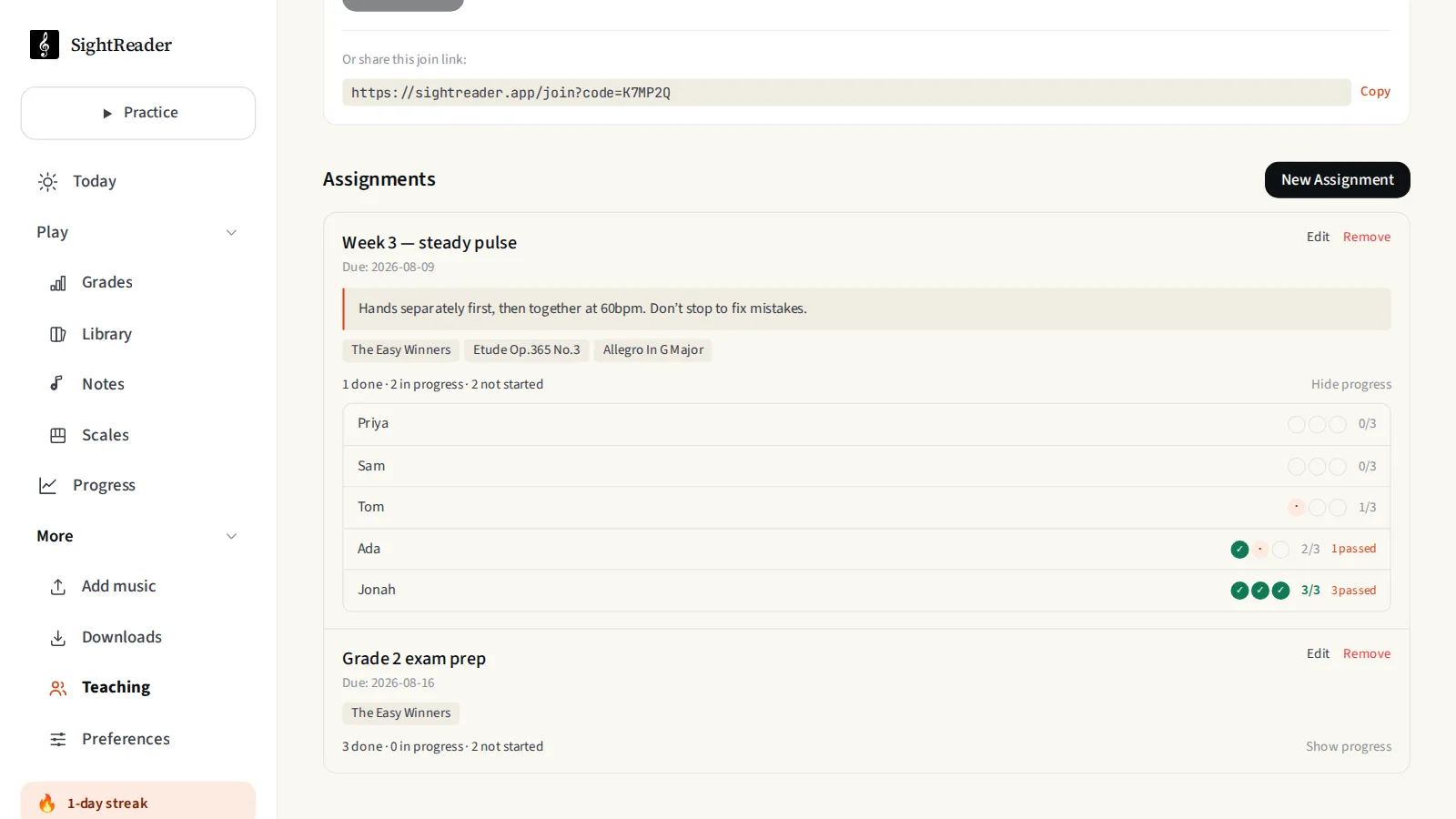
For staff, you create a class, pupils join it with a six-character code, and you can assign pieces with a due date. The roster shows each pupil’s grade, practice streak, recent pieces and where they’re getting stuck, and you can export the roster and assignment completion as CSV. Teachers get Pro free once we’ve verified that they teach. The teaching page is where that starts.
It’s worth being clear about what it isn’t. It’s a piano sight-reading practice tool, so it suits keyboard work and pianists, not a whole department’s instruments. It doesn’t mark or grade work for you, it doesn’t connect to your MIS, and there’s no single sign-on. It doesn’t teach technique or musicianship, and it doesn’t replace the lesson. What it can do is give pupils somewhere to do the reading that one lesson a week doesn’t have room for, and give you a view of whether it happened.
If you’re thinking about how reading practice could work across a year group, our schools page explains how licences and free pilots work, or you can get in touch and talk it through with me directly.
FAQ
What does Ofsted say about teaching notation in music?
Ofsted’s 2023 music subject report, Striking the right note, found that only a few schools taught staff notation well. In many others it was introduced in a single unit, or pupils met it with no expectation that they would learn to use it. The report treats being able to decode notation automatically as central to pupils using it musically.
Do pupils need to read staff notation at key stage 3?
The national curriculum for key stage 3 expects pupils to use staff and other relevant notations, and the Model Music Curriculum builds Year 7 keyboard work around playing simple melodies from staff notation on one stave. Ofsted’s report links clear end points for performing to clarity about what pupils should know of staff notation.
How can pupils get fluent at reading notation with one music lesson a week?
By reading a little in every lesson rather than in one unit a year, and by reading between lessons too. Fluency comes from many short encounters with new, easy material, spaced out over time, with feedback on whether the notes were right. A weekly lesson can introduce and check that reading, but most of the repetition has to happen elsewhere.
What is the difference between knowing notation and decoding it automatically?
A pupil who knows notation can work out a note’s name and length if given time. A pupil who decodes it automatically sees the note and plays it without stopping to work it out, which leaves their attention free for pulse, phrasing and listening. The first can be taught in a unit. The second only comes from a lot of practice.
Is there a follow-up to Ofsted’s 2023 music report?
Not at the time of writing. Striking the right note, published in September 2023, is still the subject report most music leads and inspectors refer to, alongside Ofsted’s 2021 music research review.