

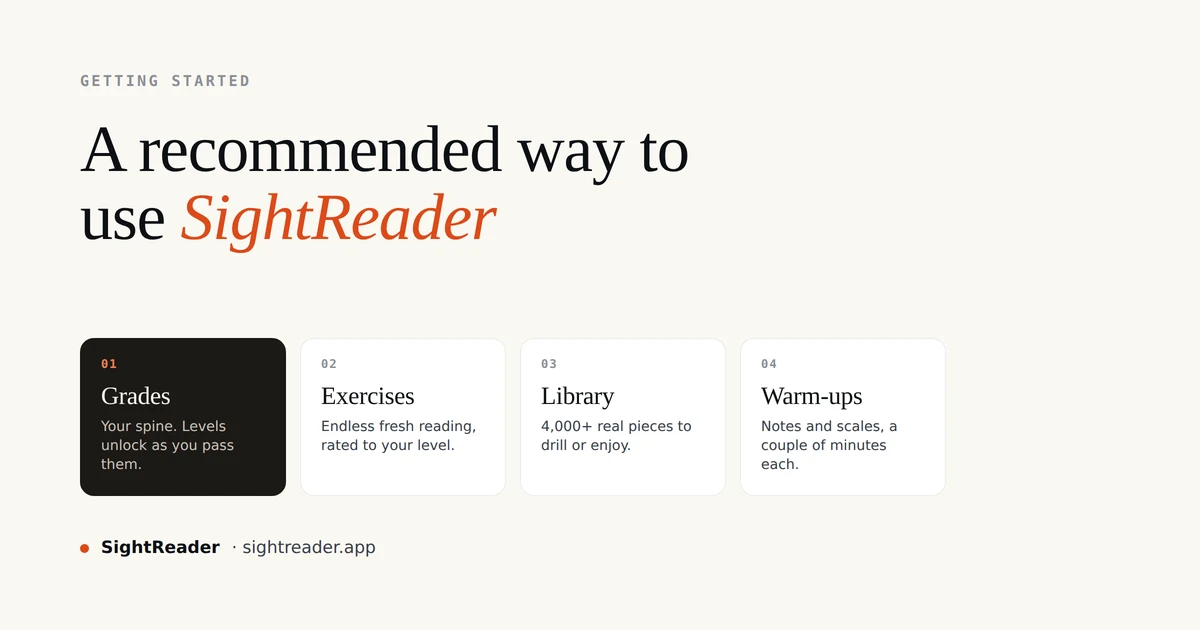
SightReader has five places you can practise, plus the graded levels if you have an exam coming up, and they all do different jobs. This is a short guide to what each one is for, which ones move you up a level on their own, and how to build ten minutes a day out of them.
The short version
Two parts of SightReader level you up automatically.
Lessons is the path. It opens the next lesson as you pass the one before it, closes each unit with a checkpoint, and opens the next grade when you finish the last. Work through it in order and you never pick the difficulty yourself. It ramps for you.
Rated exercises keep a sight-reading rating, a bit like a chess rating. Play one and your rating moves depending on how you did, and the next exercise is pitched at wherever your rating has got to. It keeps finding your edge as you improve.
The rest of it, the library and the note and scale drills, is yours to pick from. Nothing there is keeping your place, and nothing is waiting to be finished.
That is the useful thing to know at the start. Some of SightReader is a course, and some of it is a cupboard you open when you want something in particular.
What each part is for
Lessons: your spine
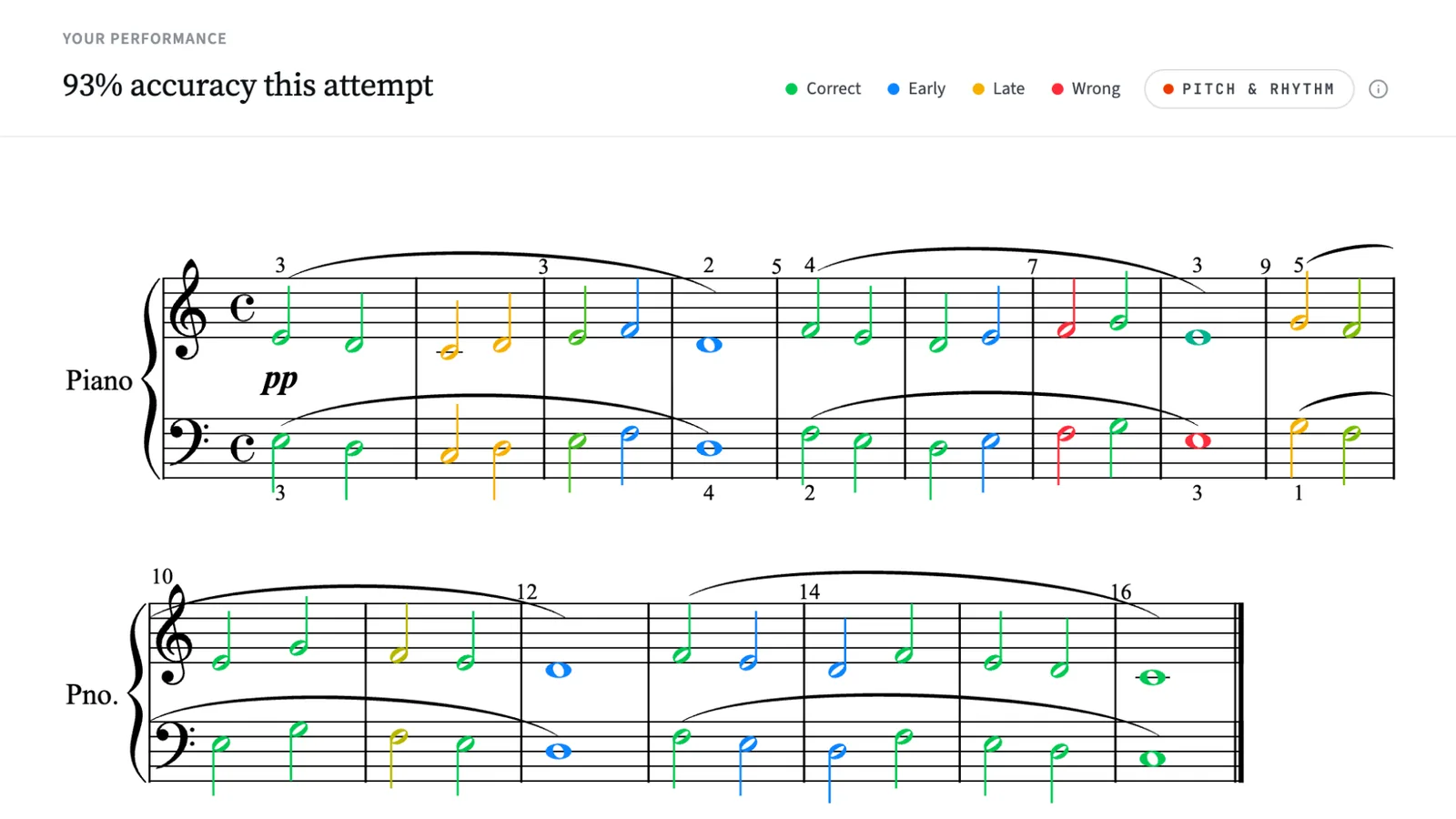
One path, from a single note on a single line all the way to Grade 8. Each lesson explains one new idea and then gives you a short piece that uses it, so there is nothing to work out on your own. We mark every note as you play, so you can see how you did without a teacher in the room.
The path runs through ten stages: Foundation and Initial, then Grades 1 to 8. Lessons open in order, each unit ends on a checkpoint, and a grade opens once you have finished the one before it.
If you are starting from nothing, start here. If you already read a bit, you do not have to grind through the beginning: take the placement test on any locked grade and, if you pass, the path skips you forward to where you actually are.
Open Lessons and it will pick up wherever you left off.
Exercises: your volume
Freshly generated pieces at your level. Nothing here has been played by anyone before, which is the whole point: you cannot sight read the same thing twice, and a piece you half remember is testing your memory rather than your reading.
Play them rated and the level looks after itself, as above. Free accounts get five rated attempts a day, plus three ordinary ones, from up to ten new exercises a day. That is more than the routine below asks for.
Each grade on the Lessons path also has an endless-exercises node at the foot of it, so once you have finished a grade you can keep reading at that level for as long as you like.
Library: real music
Over 3,700 pieces of real repertoire, plus anything you upload yourself. Two ways to use it:
- To drill something specific. Tap Refine and filter by what is in the music: triplets, staccato, dotted rhythms, a key you keep fumbling. If you know your weak spot, you can practise it directly.
- To enjoy yourself. Some days you want to read something real rather than train. That is a good enough reason, and it still counts.
If you are just starting out, the Schäfer studies are a gentle place to begin. Fifty short exercises that ramp very gradually, free on every plan.
Notes and Scales: warm-ups
These two are the ones most often mistaken for courses. They are warm-ups.
Notes puts one note on the stave at a time until you know them without working them out. If you still count up from middle C, two minutes of this before you play anything else will do more for your reading this month than any amount of repertoire.
Scales covers all 24 keys with arpeggios and fingering. Most of what you sight read is scale shapes in disguise, so a minute in the key of whatever you are about to play is never wasted.
Neither has an end. Do a little, then get on with the reading.
Quiz is the one you can do away from the piano: ten questions on intervals, key signatures and notation, with real music to read on screen. Three minutes on the bus still counts.
Grades: exam practice
The graded levels are still here, under Exam practice. Nine tracks, Initial through Grade 8, plus a standalone Notation Practice set, each holding progressive levels written to the ABRSM sight-reading parameters: the keys, time signatures, hand positions and lengths the syllabus sets at each stage. On Pro, finishing a grade earns a certificate.
The difference between this and Lessons is what each one is for. Lessons teaches you the material. Grades rehearses the test. If you have an exam coming up, work the grade that matches it alongside the path. If you do not, the path is the one to follow.
Not sure which grade you are on? If you have an account, the placement test on any locked grade in Lessons will place you. If you have not signed up yet, the placement check takes about three minutes and needs no account. Whatever either tells you, consider starting a grade lower. Sight reading always lags the repertoire you can learn over weeks, and reading music that is slightly too easy is the most reliable way to get better at it. Reading music that is slightly too hard mostly teaches you to stop.
A routine that works
Ten to fifteen minutes a day, most days. That beats an hour at the weekend, and the reason is how the brain files skills, not willpower. Even five minutes has real value on the days you cannot find ten. I have written about the research behind that if you want the detail, and there is a fuller picture of the whole skill in our ultimate guide to piano sight reading.
- Two minutes: warm up. A note drill, or a scale in the key you are about to read.
- Six minutes: the reading itself. One lesson, or a rated exercise or two. Play it straight through, once, without stopping. If your fingers fall apart in bar three, keep going anyway. Recovering your place mid-piece is the skill. Stopping to fix it is the habit that ruins sight reading.
- Three minutes: something real. Anything from the library you fancy.
Then close the lid. Tomorrow, do the same with different music.
Two things worth not doing
Do not replay a piece to push the stars up. It is tempting, because the score goes up and that feels like progress. But the second read is memory rather than sight reading, and the number you are improving stops measuring the thing you care about. Play it once, take the score you got, move on.
Do not try to do a bit of each section every day. Five surfaces in ten minutes is five minutes of navigating and five minutes of practice. Pick your spine, Lessons or rated Exercises, and let the rest be occasional.
What is free, and what is not
The free plan covers this routine comfortably: the whole of Foundation and Initial in Lessons plus the first unit of Grade 1, unlimited note and scale drills, five rated exercises a day plus three ordinary ones (from up to ten new exercises a day), 54 free study pieces including the whole Schäfer book, and the first five levels of every grade from Initial to Grade 5 in Exam practice.
Pro opens the rest of the Lessons path, the remaining grade levels, Grades 6 to 8 in full, the rest of the 3,700-piece library, and a curated five-piece session waiting for you each day on the Today page.
If you are on the free plan and you follow the routine above, you will not run out of material for a good while.
If you get stuck
Most questions are answered in the FAQ, and the keyboard setup guide covers connecting a piano. If you are still stuck, write to hello@sightreader.app. If a part of SightReader does not explain itself, that is worth knowing about, and it is usually something we can fix.