

Le grade 6 est le niveau où le déchiffrage cesse de consister à lire des notes pour devenir la lecture de tout un tissu musical d’un seul coup. Le morceau devant toi peut être en 9/8 ou en 5/4, il portera probablement des indications de pédale, il peut comporter un triolet contre un duolet, et quelque part sur la page il y aura un gruppetto ou un mordant dont il te faudra décider si tu le joues. Tu n’as toujours qu’une courte fenêtre de préparation. Tu dois toujours continuer.
C’est aussi le premier grade d’ABRSM où la Théorie de grade 5 est un prérequis formel pour l’examen pratique. Tu ne peux pas te présenter au grade 6 de piano avec ABRSM sans avoir le certificat de théorie en main, et l’épreuve suppose désormais que tu sais ce que signifie chaque symbole sur la page. Cela change la forme du travail. Le but n’est plus de décoder une indication inconnue, mais de l’exécuter sous pression.
Ce guide couvre ce qu’attendent les principaux jurys au grade 6, comment se préparer à l’épreuve, et quels morceaux de SightReader se situent au bon niveau pour s’entraîner.
Ce qu’attendent les examinateurs au grade 6
Au grade 6, le morceau fait généralement de douze à seize mesures, dans n’importe quelle tonalité majeure ou mineure jusqu’à quatre dièses ou quatre bémols, les mains jouant désormais fermement ensemble du début à la fin. Le vocabulaire rythmique inclut des groupements en triolets, des syncopes simples et des notes liées par-dessus la barre de mesure, et l’éventail des mesures dépasse les familiers 2/4, 3/4, 4/4, 3/8 et 6/8 pour inclure 9/8, 5/8 et 5/4. Les indications de pédale apparaissent pour la première fois à ce niveau. Les nuances couvrent toute la plage de pp à ff avec cresc., dim. et des accents, et tu peux t’attendre à une articulation mixte et à des accords à quatre parties avec jusqu’à deux notes par main. La fenêtre de préparation reste inchangée par rapport aux grades précédents : de trente secondes à une demi-minute d’étude silencieuse ou audible avant le début de l’épreuve. Là où les jurys diffèrent, c’est surtout sur la longueur, la couverture des tonalités, le temps de préparation, et le caractère obligatoire ou non de l’épreuve.
| Jury | Longueur | Tonalités | Position des mains | Altérations | Préparation | Obligatoire au grade 6 ? |
|---|---|---|---|---|---|---|
| ABRSM (Royaume-Uni) | 12–16 mesures | Jusqu’à 4♯/4♭ majeures ; jusqu’à 4♯/4♭ mineures (ajoute do♯ mineur, fa mineur à ce grade) | Mains ensemble | Fréquentes | 30 secondes | Oui |
| Trinity (Royaume-Uni) | ~12 mesures | Majeures et mineures jusqu’à 4♯/4♭ | Mains ensemble | Fréquentes | 30 secondes | Non, une des quatre épreuves de soutien au choix |
| LCM (Royaume-Uni) | ~12–14 mesures | Majeures et mineures jusqu’à 4♯/4♭ | Mains ensemble | Fréquentes | 60 secondes | Oui |
| RCM (Canada et États-Unis) | Court | Majeures et mineures jusqu’à 4♯/4♭ | Mains ensemble | Fréquentes | Coup d’œil bref | Oui (le déchiffrage est obligatoire à partir du niveau 6) |
| MTAC Certificate of Merit (États-Unis) | Court | Majeures et mineures jusqu’à 4♯/4♭ | Mains ensemble | Fréquentes | Coup d’œil bref | Oui |
| AMEB (Australie) | Court | Majeures et mineures jusqu’à 4♯/4♭ | Mains ensemble | Fréquentes | Coup d’œil bref | Oui en Comprehensive ; au choix avec l’oral en Piano for Leisure |
Quelques différences valent la peine d’être connues. Le grade 6 d’ABRSM est la frontière où le prérequis de Théorie de grade 5 entre en jeu, ce qui distingue son examen pratique d’un grade 6 de Trinity ou LCM où il n’y a aucune barrière formelle de théorie. Trinity continue de permettre aux candidats d’éviter complètement le déchiffrage en choisissant une autre épreuve de soutien, mais à ce niveau les alternatives (improvisation, connaissances musicales) sont elles-mêmes plus difficiles qu’au grade 1, si bien que le contournement de l’épreuve n’est plus l’option facile. Le niveau 6 de RCM est le seuil à partir duquel le déchiffrage devient une partie obligatoire de l’examen plutôt qu’une épreuve de soutien facultative : le candidat qui passe le RCM 6 pour la première fois rencontre donc l’épreuve pour de bon. LCM laisse encore une minute entière de préparation, ce qui au grade 6 est très utile : une minute suffit pour compter une mesure irrégulière, décider du groupement d’un 5/8 et essayer en silence le passage le plus délicat.
La forme de l’épreuve est stable depuis des décennies, mais les nombres exacts de mesures, la couverture des tonalités et le vocabulaire rythmique sont révisés d’un cycle de programme à l’autre dans des limites étroites. Consulte le programme en vigueur de ton jury avant de passer l’examen.
Comment travailler le déchiffrage au grade 6
Le travail qui forme un déchiffreur sûr de lui au grade 6 n’est plus celui qui forme un déchiffreur sûr de lui au grade 3, à plus grande échelle. La compétence est qualitativement différente. Au grade 6, l’œil doit absorber plus d’informations à la fois, le pied a une tâche, et la main doit respecter des groupements rythmiques que le corps n’a pas encore intériorisés. Si tu as lu notre guide principal pour progresser en déchiffrage, une partie te semblera familière. Les points propres au grade sont ci-dessous.
Lis les indications de pédale dans la fenêtre de préparation. Le grade 6 est le premier grade où le pied a une tâche. Cherche Ped. et le signe de relâcher *, ou la notation moderne par crochets, pendant ton balayage. L’erreur la plus fréquente à ce niveau n’est pas de ne pas pédaler du tout, mais de pédaler à travers un changement d’harmonie, ce qui produit une bouillie trouble que les examinateurs repèrent immédiatement. Repère mentalement les changements d’harmonie avant de commencer. La pédale se relève quand l’harmonie change.
Décide du groupement d’une mesure irrégulière avant de commencer. Le 5/8 est soit 3+2 soit 2+3. Le 5/4 est soit 3+2 soit 2+3 de noires. Le morceau te dit généralement lequel par les ligatures et le placement des accents, mais il faut regarder. Décide dans la fenêtre de préparation. Une fois le groupement en tête, compte-le à voix haute pendant que tu balaies le reste de la page, pour que l’irrégularité soit déjà dans ton corps quand tu t’assieds pour jouer.
Traite les triolets et les duolets comme un changement rythmique, pas comme des notes plus rapides. Quand tu vois un 3 au-dessus de trois notes dans une mesure de 2/4 ou 4/4, les trois notes occupent le temps de deux. La main et le pied doivent s’accorder là-dessus. Travaille ça en comptant « un-deux-et-trois » pour la mesure du triolet et « un-et-deux-et » pour le duolet autour. Si tu hésites sur une mesure, ralentis le tempo des mesures voisines plutôt que de précipiter le triolet.
Lis les ornements comme une décoration, pas comme l’essentiel. Si tu ne peux pas caser proprement un gruppetto ou un mordant à tempo, joue la note principale et continue. Les examinateurs préfèrent entendre la ligne plutôt que de t’entendre t’arrêter pour résoudre un symbole. Le fait d’avoir reconnu l’ornement et choisi de le sauter est en soi une marque de jugement musical à ce niveau.
Pour le 9/8, ressens trois pulsations de noire pointée, comme le 6/8 en faisait deux. Ne compte pas neuf croches. La pulsation ternaire composée a un balancement qui disparaît si tu la comptes en croches. Le corps doit ressentir les trois grandes pulsations. Tape-les sur le pupitre pendant la fenêtre de préparation si besoin.
Prépare l’examen avec les leçons de grade 6 de SightReader
Les Leçons de SightReader t’accompagnent à travers le grade 6, une courte leçon à la fois, autour des mêmes contraintes que celles des examinateurs. C’est le premier grade entièrement réservé à Pro, en leçons comme en entraînement à l’examen, parce que l’effort d’ingénierie et de composition pour construire du matériel de déchiffrage à ce niveau est bien plus important et que le public est plus engagé. Si tu déchiffres au grade 6, SightReader Pro est la version de la plateforme faite pour toi.
Les tonalités d’ABRSM sont cumulatives, donc le grade 6 met à l’épreuve do♯ mineur et fa mineur (les nouvelles tonalités à ce grade) en plus de chaque tonalité depuis Initial jusqu’au grade 5. Chaque leçon enseigne une seule chose, puis te donne de courts morceaux, avec des mesures irrégulières et des indications de pédale lorsqu’elles cadrent avec son objectif, rattachés à l’un des mondes rythmiques que tu rencontreras dans le carnet d’un examinateur. Quand tu veux répéter, l’entraînement à l’examen du grade 6 propose des morceaux gradués exactement à ce niveau.
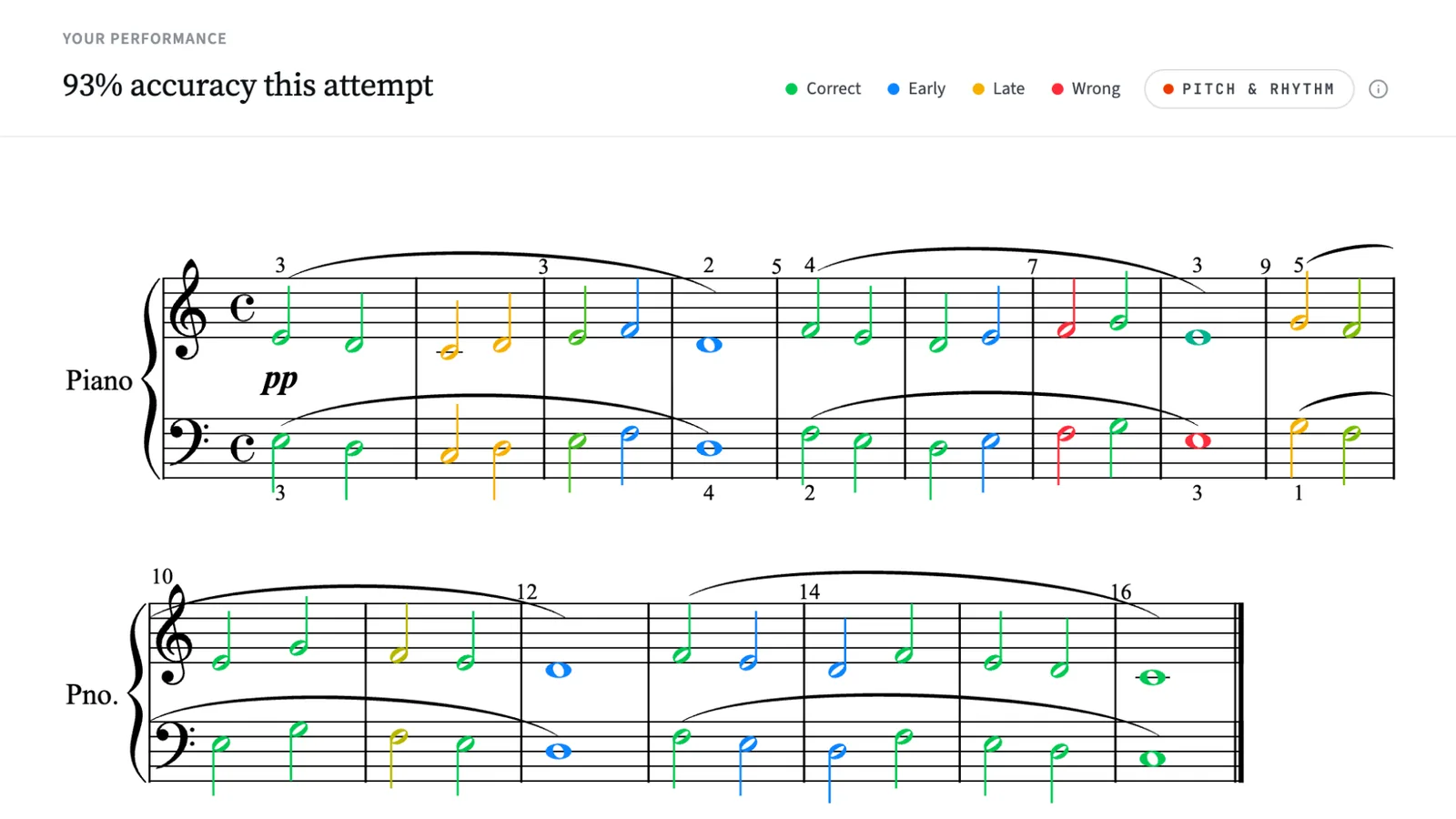
Le jalon de préparation à l’examen le plus concret que nous puissions recommander est celui-ci : lis des morceaux du grade 6 avec une précision de 90 % ou plus avant de passer l’examen. C’est le standard qu’un examinateur de grade 6 qualifierait d’assuré, et le retour piloté par le curseur dans SightReader rend facile de voir où tu es sous la barre. Un deuxième jalon, pour ceux qui visent la distinction : lis une série complète de morceaux d’entraînement du grade 6 sans descendre sous 75 % sur aucun d’eux.
Des morceaux de la bibliothèque SightReader à déchiffrer à ce niveau
Les leçons de grade 6 ci-dessus reposent sur du matériel de déchiffrage conçu sur mesure. La bibliothèque SightReader est l’autre versant de la plateforme : des milliers de vrais morceaux de vrais compositeurs, étiquetés par difficulté. Les morceaux marqués en difficulté 4 et difficulté 5 se situent au niveau de déchiffrage du grade 6.
Soyons honnêtes là-dessus : la bibliothèque n’a pas de colonne vertébrale gratuite à cette difficulté comme le Sight Reading Book 1 de Christian Schäfer ancre le grade 1. En parcourant la bibliothèque par difficulté, tu trouveras des morceaux plus faciles parmi les préludes et valses de Chopin, plusieurs pièces de l’Album pour la jeunesse de Schumann, des inventions à deux voix de Bach (qui sont une tâche de déchiffrage de grade 6 et plus, même si certaines sont enseignées plus tôt comme pièces d’étude), des pièces de l’Album pour la jeunesse de Tchaïkovski, et des nocturnes faciles de Field. À ce niveau, ces morceaux sont verrouillés derrière Pro.
Deux endroits pour commencer à parcourir :
- Bibliothèque, difficulté 4. L’Album pour la jeunesse de Schumann est le repère unique le plus solide ici. Lis un morceau, passe au suivant. Traite chacun comme un déchiffrage unique.
- Bibliothèque, difficulté 5. Les préludes et valses les plus faciles de Chopin et les inventions à deux voix de Bach les plus abordables vivent ici. Les inventions, en particulier, sont un excellent matériel de déchiffrage parce que la texture est pleinement à deux voix, ce qui est la compétence que le grade 7 poussera ensuite.
Si tu as un compte SightReader Pro, le reste du catalogue de difficulté 4 et 5 s’ouvre. Utilise le filtre de difficulté de la bibliothèque, traite chaque morceau comme un déchiffrage unique, et passe au suivant. C’est ce travail-là qui construit la compétence, pas le fait de jouer chacun dix fois jusqu’à le mémoriser.
Pièges courants au grade 6
Trois erreurs expliquent la plupart des points perdus à ce niveau.
La première, c’est pédaler à travers un changement d’accord. Le candidat voit une indication de pédale, garde la pédale enfoncée pendant la durée indiquée, et ignore que l’harmonie a bougé en dessous. Le résultat est une bouillie trouble que les examinateurs entendent depuis la porte. La solution est de lire d’abord la ligne de basse et de relever la pédale à chaque changement d’harmonie, même si le relâcher indiqué n’arrive qu’à la fin de la mesure.
La deuxième, c’est mal lire un ornement et s’arrêter pour le résoudre. Un gruppetto ou un mordant sur la page est une décoration de la note principale. Si tu ne peux pas le placer proprement à tempo, joue la note principale. S’arrêter pour décoder l’ornement coûte bien plus de points que de le sauter. Le candidat qui continue d’avancer et joue la ligne proprement marque toujours plus que celui qui s’arrête pour exécuter l’ornement correctement.
La troisième, c’est compter le 5/4 comme un 4/4 rapide avec un temps en plus collé au bout. L’irrégularité d’une mesure irrégulière doit sembler intentionnelle. Si tu comptes cinq noires égales comme quatre plus une, la mesure sonne comme une erreur. Décide 3+2 ou 2+3 dans la fenêtre de préparation, accentue mentalement le premier temps de chaque sous-groupe, et laisse la mesure paraître asymétrique à dessein.
Travaille le déchiffrage du grade 6 dans SightReader
Les Leçons de SightReader couvrent le grade 6 avec du matériel de déchiffrage aligné sur le grade, construit autour des mêmes contraintes que celles des examinateurs : les nouvelles tonalités (do♯ mineur, fa mineur), les nouvelles mesures (9/8, 5/8, 5/4), les indications de pédale, les rythmes en triolets, et tout l’éventail cumulatif des tonalités depuis Initial. Chaque leçon est courte, chaque morceau est un déchiffrage unique, et le retour piloté par le curseur te montre où tu as laissé tomber des notes au moment où tu termines. Pour répéter, l’entraînement à l’examen du grade 6 propose des morceaux gradués à ce niveau. Le grade 6 est réservé aux membres Pro. Si tu te prépares au grade 6, c’est la version de SightReader pensée pour toi.
Avant ça, et la suite
- Avant ça : Comment travailler le déchiffrage au piano au grade 5, pour ceux qui consolident le travail de modulation et d’accords à quatre parties sur lequel le grade 6 s’appuie.
- La suite : Comment travailler le déchiffrage au piano au grade 7, pour ceux qui passent du grade 6 à la suite.
FAQ
Combien de temps devrais-je travailler le déchiffrage au grade 6 ?
Dix à quinze minutes par jour, tous les jours, valent mieux qu’une heure deux fois par semaine. Au grade 6, les nouvelles compétences (mesures irrégulières, coordination de la pédale, sensation du triolet) se consolident entre les séances, pas pendant. Une séance quotidienne qui inclut un morceau en mesure irrégulière et un morceau avec des indications de pédale est plus utile qu’une longue séance qui ne travaille qu’un seul des deux.
Quel est l’équivalent du grade 6 dans les autres jurys d’examen ?
Le grade 6 correspond de très près entre ABRSM, Trinity, LCM et AMEB. Les équivalents nord-américains les plus proches sont le niveau 6 de RCM (le programme de certification du Royal Conservatory) et le niveau 6 du MTAC Certificate of Merit. Le grade 6 est aussi le niveau où les exigences formelles des jurys commencent à diverger de manière significative : ABRSM verrouille l’examen pratique derrière la Théorie de grade 5 à ce niveau, alors que Trinity, LCM, RCM et MTAC n’imposent pas de prérequis de théorie équivalent.
Comment lire les indications de pédale à vue ?
La pédale se relève quand l’harmonie change, peu importe où se trouve le signe de relâcher imprimé. Lis d’abord la ligne de basse pendant la fenêtre de préparation et repère où les accords changent. Garde la pédale jusqu’au changement suivant, puis relève-la proprement. L’erreur la plus fréquente est de suivre littéralement le relâcher imprimé et de pédaler à travers un changement d’harmonie.
Comment lire le 5/8 et le 5/4 à vue ?
Décide du groupement dans la fenêtre de préparation. Le 5/8 est soit 3+2 soit 2+3 croches, et le 5/4 est pareil avec des noires. Le morceau te le dit par les ligatures et les accents. Une fois le groupement choisi, compte-le à voix haute (un-deux-trois-un-deux pour 3+2, et un-deux-un-deux-trois pour 2+3) et laisse la mesure paraître asymétrique à dessein.
Dois-je jouer tous les ornements ?
Non. Si un gruppetto ou un mordant se case proprement à tempo, joue-le. Sinon, joue la note principale et continue. Les examinateurs récompensent la ligne ininterrompue plutôt que l’ornement correctement décodé. Le jugement de sauter un ornement est en soi une compétence de grade 6.
Combien de temps avant d’être prêt pour le grade 7 ?
Termine les leçons de grade 6, puis parcours l’entraînement à l’examen du grade 6. Si tu peux lire ces morceaux avec une précision de 90 % ou plus, sans t’arrêter, tu es au niveau où le matériel de grade 7 commence à être utile. Le signal de transition le plus fiable est la régularité sur les morceaux en mesure irrégulière et sur ceux à indications de pédale, pas seulement sur les morceaux dans des tonalités familières.
Sources
- ABRSM Piano Practical Grades Syllabus 2023 & 2024, spécifications de déchiffrage ; prérequis de Théorie de grade 5 pour les grades 6–8 pratiques. https://www.abrsm.org/sites/default/files/2023-09/piano-2023-2024-practical-grades-syllabus-may-2022.pdf
- LCM Examinations, Music Grades Specification. https://lcme.uwl.ac.uk/media/jeelt5f4/music-grades-specification.pdf