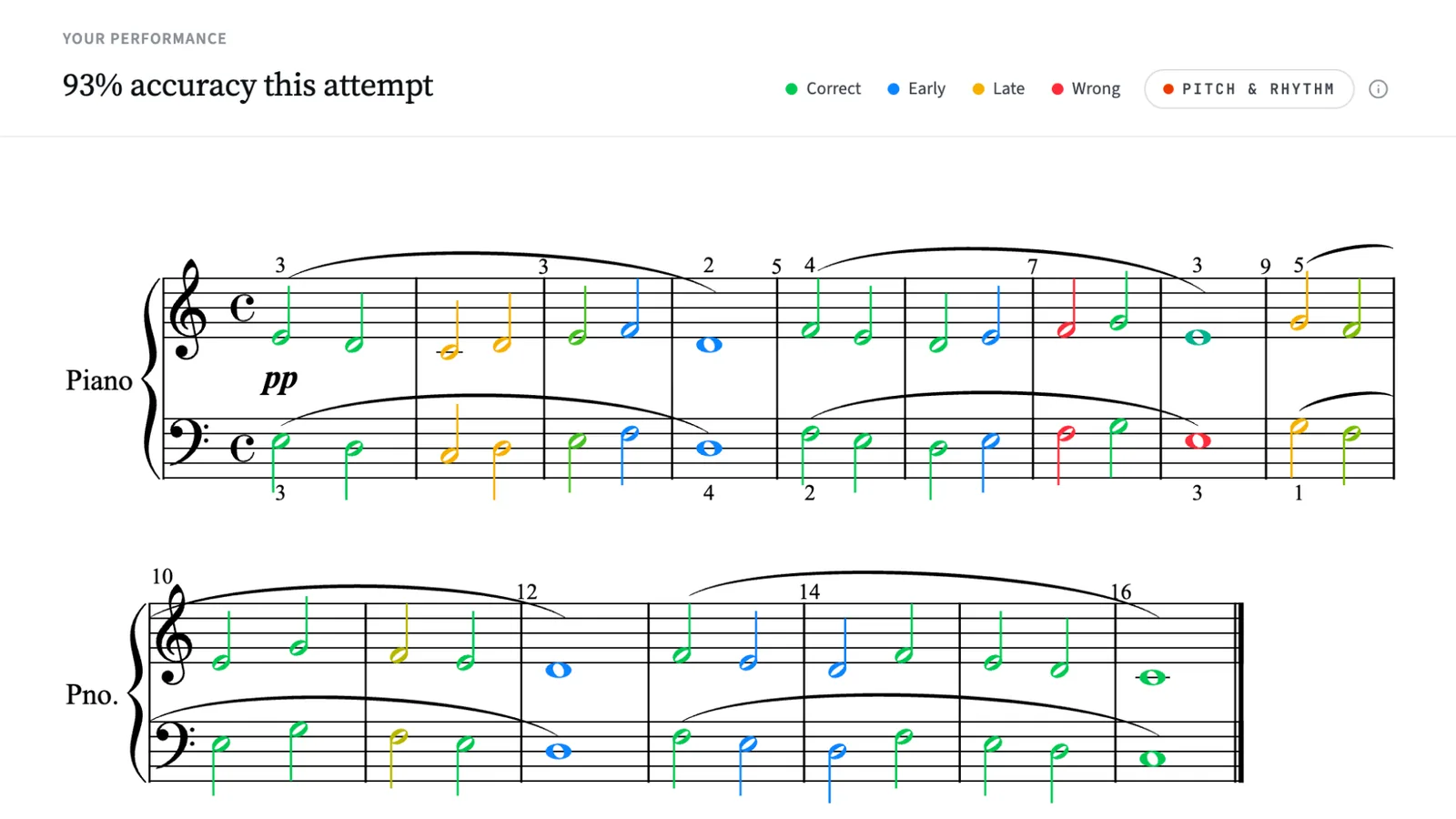



Le grade 5 est le niveau où le déchiffrage cesse d’être un test de notes pour devenir un test d’anticipation. Le morceau est plus long, les modulations sont réelles, les accords sont à quatre voix, et l’étendue dynamique va désormais de pp à ff. Tu ne peux plus parcourir une fois puis jouer. Tu dois continuer à lire tout au long du morceau, une mesure en avance sur l’endroit où sont tes mains, pendant que la musique sous tes yeux change de tonalité.
C’est aussi le grade qui commande le reste de l’échelle au Royaume-Uni : la théorie du grade 5 ABRSM est le prérequis de tout examen pratique à partir du grade 6. Le déchiffrage et la théorie sont des épreuves distinctes, mais les tonalités, les modulations et le vocabulaire rythmique que tu rencontres ici sont les mêmes. Si tu lis avec fluidité au grade 5, l’épreuve de théorie consistera surtout à écrire ce que tu entends déjà.
Ce guide couvre ce qu’attendent les principaux jurys d’examen au grade 5, comment se préparer à l’épreuve, et quels morceaux de SightReader se situent au bon niveau pour s’entraîner.
Ce qu’attendent les examinateurs au grade 5
Les jurys de piano s’accordent à dire que le grade 5 est le seuil où le test de déchiffrage devient un véritable exercice technique. Quel que soit le jury sous lequel tu passes, le morceau fait environ huit à douze mesures, peut être dans n’importe quelle mesure courante, y compris 3/8 et 6/8, et puise dans un réservoir de tonalités cumulatif qui inclut désormais trois ou quatre dièses et bémols. Des accords à quatre voix apparaissent, avec au maximum deux notes dans chaque main, mais répartis entre les deux portées, si bien que tu dois lire les deux à la fois. L’étendue dynamique va de pp à ff. La syncope, les liaisons par-dessus les barres de mesure, un ralentissement du tempo à la fin (rit. ou rall.) et tout l’éventail des signes d’articulation rencontrés aux grades inférieurs sont au programme. Là où les jurys diffèrent, c’est surtout sur la longueur, la couverture des tonalités, le temps de préparation, et le caractère obligatoire ou non de l’épreuve.
| Jury | Longueur | Tonalités | Position des mains | Altérations | Préparation | Obligatoire au grade 5 ? |
|---|---|---|---|---|---|---|
| ABRSM (R-U) | 8-12 mesures | do, sol, fa, ré, la, si♭, mi♭, mi, la♭ majeur ; la, ré, mi, sol, si, fa♯, do mineur (cumulatif ; jusqu’à 4 dièses/bémols) | Deux mains, modulations | Courantes, y compris dans les modulations | 30 secondes | Oui |
| Trinity (R-U) | ~8-10 mesures | Cumulatives, proches d’ABRSM | Deux mains, modulations simples | Courantes | 30 secondes | Non, l’un des quatre tests de soutien au choix |
| LCM (R-U) | ~8 mesures | Jusqu’à 4 dièses/bémols | Deux mains | Courantes | 60 secondes | Oui |
| RCM (Canada et États-Unis) | ~6-8 mesures | Jusqu’à 3 dièses/bémols | Deux mains, mains ensemble | Courantes | Coup d’œil bref | Optionnel au niveau 5 (l’un des quatre tests de soutien au choix) ; obligatoire à partir du niveau 6 |
| MTAC Certificate of Merit (É-U) | ~6-8 mesures | Cumulatives jusqu’à 3 dièses/bémols | Deux mains | Courantes | Coup d’œil bref | Oui |
| AMEB (Australie) | ~8 mesures | Cumulatives jusqu’à 3 dièses/bémols | Deux mains | Courantes | Coup d’œil bref | Oui en Comprehensive ; au choix avec l’oral en Piano for Leisure |
Quelques différences valent la peine d’être connues. Trinity te laisse encore choisir un test de soutien différent à la place du déchiffrage à ce grade, ce qui est plus rare au grade 5 qu’au grade 1, mais possible. Le niveau 5 de RCM est le dernier niveau où le déchiffrage est optionnel, et à partir du niveau 6, il devient obligatoire. La minute entière de préparation de LCM compte plus ici qu’aux grades inférieurs : elle te donne un vrai temps pour repérer la modulation, entendre le rit. et planifier les formes des accords à quatre voix avant le premier temps. ABRSM publie la spécification la plus explicite, et les longueurs de mesures et les vocabulaires rythmiques sont révisés entre deux cycles de programme dans des marges étroites. Vérifie le programme en vigueur de ton jury avant de passer l’examen.
Une note pratique pour les candidats britanniques : la théorie du grade 5 ABRSM (ou l’une des alternatives acceptées) est le prérequis pour passer tout examen pratique ABRSM à partir du grade 6. L’épreuve de théorie est distincte du déchiffrage, mais les armures, les modulations et le vocabulaire rythmique se recoupent largement. Si tu travailles bien le déchiffrage au grade 5, l’épreuve de théorie te paraîtra familière plutôt qu’étrangère.
Comment travailler le déchiffrage au grade 5
La technique qui t’a fait passer le grade 4 ne suffit plus. Le grade 5 exige que tu lises en avant pendant que tes mains restent en arrière, que tu suives deux lignes d’articulation à la fois, et que tu traites un accord à quatre voix comme une structure plutôt que comme quatre notes individuelles. Si tu as lu notre guide principal pour progresser en déchiffrage, les grands principes y sont. Les points propres au grade sont ci-dessous.
Lis la modulation comme un bloc, pas comme une surprise. La plupart des morceaux de grade 5 modulent une fois, généralement vers la dominante ou le relatif mineur. Le pivot se situe vers la mesure 4 ou 5, et la nouvelle tonalité est installée soit par des altérations, soit par un changement d’armure imprimé. Trouve la mesure pivot pendant la fenêtre de préparation, nomme la nouvelle tonalité dans ta tête, et répète en silence le premier accord de la nouvelle tonalité sur le clavier. Si tu arrives à la modulation à froid, tu hésiteras. Si tu as déjà imaginé la nouvelle tonalité, la mesure pivot se joue toute seule.
Lis une mesure en avance sur tes mains. C’est la technique qui sépare les candidats du grade 5 qui réussissent de ceux qui s’en sortent de justesse. Ton œil devrait toujours regarder la mesure qui suit celle que tu joues. Si ton œil est sur la note que tu fais sonner, le prochain changement de texture, de nuance ou d’articulation te prendra de court. Travaille cela en masquant des mesures avec une carte pendant que tu joues, pour que ton œil soit forcé d’aller en avant.
Traite un accord à quatre voix comme deux intervalles simultanés. Le grade 5 ABRSM introduit les accords de quatre notes, mais le programme limite chaque main à deux notes. Cela veut dire qu’un accord à quatre voix, c’est un intervalle à la main droite et un intervalle à la main gauche, sonnés ensemble. N’essaie pas de lire quatre lignes empilées à la verticale. Repère l’intervalle de la main droite, repère l’intervalle de la main gauche, et laisse les deux formes tomber sous tes doigts en parallèle.
Planifie le rit. avant de jouer la première note. Le ralentissement de la fin est une instruction écrite, pas une suggestion. Les candidats qui décident où ils vont ralentir avant le début du morceau réussissent une fin nette. Ceux qui improvisent le rit. commencent en général trop tôt, manquent de marge pour ralentir, et finissent sur un accord final coincé. Choisis la mesure, entends le nouveau tempo, puis pars.
Travaille la syncope simple en frappant les contretemps. La syncope entre au grade 5, et beaucoup de candidats lisent les symboles correctement mais ressentent le rythme de travers. Frappe le contretemps d’une main pendant que l’autre joue le temps fort. Fais-le loin du piano pendant une minute avant de commencer une séance. La familiarité avec la sensation compte plus que le symbole visuel sur la page.
Prépare l’examen avec les leçons du grade 5 de SightReader
Les Leçons de SightReader t’accompagnent à travers le grade 5, une courte leçon à la fois, autour des mêmes contraintes que celles des examinateurs : les nouvelles tonalités (mi majeur, la♭ majeur, fa♯ mineur, do mineur) plus le réservoir de tonalités cumulatif des grades 1 à 4, les accords à quatre voix répartis entre les mains, la syncope simple, le rit. ou rall. à la fin, et toute l’étendue dynamique de pp à ff. Chaque leçon enseigne une seule chose, puis te donne de courts morceaux à lire dans un univers harmonique et rythmique précis que tu retrouveras dans le cahier d’un examinateur. Quand tu veux répéter, l’entraînement à l’examen du grade 5 propose des morceaux gradués exactement à ce niveau.
Le jalon concret de préparation à l’examen que nous recommandons à chaque grade : lis des morceaux du grade 5 avec 90 % de précision ou plus avant de passer l’examen. C’est le standard qu’un examinateur du grade 5 qualifierait d’assuré, et le retour piloté par le curseur de SightReader rend facile de voir où tu es sous la barre. Les grades sont cumulatifs chez ABRSM, alors une fois le grade 5 maîtrisé, fais quelques séances dans les grades 4 et 3 pour garder les anciennes tonalités à jour. Un test en si♭ majeur au grade 5 n’est pas plus facile qu’il ne l’était au grade 3.
Un second jalon, pour les candidats à la mention : lis une série complète de morceaux d’entraînement du grade 5 sans descendre sous 75 % sur aucun d’entre eux. Le grade 5 est le niveau où un travail inégal selon les tonalités commence à se voir à l’examen, et ce jalon filtre le schéma « seulement les bons jours ».
Des morceaux de la bibliothèque SightReader à déchiffrer à ce niveau
Les leçons du grade 5 ci-dessus reposent sur du matériel de déchiffrage conçu sur mesure. La bibliothèque SightReader est l’autre versant de la plateforme : des milliers de vrais morceaux de vrais compositeurs, étiquetés par difficulté. Les morceaux marqués en difficulté 5 se situent au niveau de déchiffrage du grade 5.
Une note honnête. En difficulté 5, le catalogue est entièrement de niveau Pro. Il n’y a pas d’épine dorsale gratuite équivalente au recueil de Christian Schäfer que nous recommandons au grade 1. La bibliothèque gratuite a d’abord été bâtie autour du matériel des premiers grades, et à partir de la difficulté 5, c’est derrière le paywall. Si tu as un compte SightReader Pro, parcours le niveau sur /library?difficulty=5 et tu trouveras le genre de morceaux qui se lisent comme du matériel d’examen de grade 5 : les inventions à deux voix de Bach, des sonatines de Clementi de l’Op. 36, des études plus faciles de l’Op. 109 de Burgmüller, des numéros plus tardifs de l’Op. 39 de Kabalevski, et des morceaux des Cahiers 3 et 4 du Mikrokosmos de Bartók. Chacun fait à peu près la longueur d’un morceau d’examen et utilise le même vocabulaire harmonique et de texture.
Si tu n’es pas en Pro, les cinq premiers niveaux de l’entraînement à l’examen du grade 5 sont gratuits et restent la meilleure pratique gratuite à ce niveau. La bibliothèque est un complément, pas un substitut.
Pièges courants au grade 5
Trois erreurs expliquent l’essentiel des points perdus à ce niveau.
La première, c’est ralentir à la modulation plutôt qu’au rit. indiqué. La modulation est censée couler. Un accord pivot n’est pas un moment d’hésitation. Les examinateurs entendent un ralentissement au changement de tonalité comme un défaut de lecture en avant, pas comme un jeu expressif. Le remède, c’est de connaître la nouvelle tonalité avant d’y arriver, pour que la mesure pivot ne ressemble pas à une question.
La deuxième, c’est jouer un accord à quatre voix en oubliant une note dans une main. Au tempo de jeu, c’est difficile de s’en rendre compte soi-même, surtout si la note manquante est à la main gauche. Le remède est dans la préparation : quand tu vois un accord à quatre voix dans la fenêtre d’aperçu, repère explicitement les deux intervalles. Main droite : tierce. Main gauche : sixte. Maintenant les deux formes ont un nom. Une forme nommée est plus dure à jouer à moitié qu’une forme sans nom.
La troisième, c’est calquer l’articulation d’une main sur l’autre. Quand la main droite est en staccato et la main gauche en legato, la plupart des candidats jouent instinctivement les deux en legato ou les deux en staccato. Les deux lignes sont censées sonner différemment. Le remède, c’est de balayer les signes d’articulation de chaque main pendant la préparation et de jouer la première mesure dans ta tête avec le bon toucher à chaque main.
Travaille le déchiffrage du grade 5 dans SightReader
De courtes leçons calées sur l’univers harmonique et rythmique du programme du grade 5 ABRSM, chacune centrée sur une seule chose, avec un retour piloté par le curseur au niveau de la note et le réservoir de tonalités cumulatif des grades 1 à 4 en dessous. Vise 90 % de précision sur des morceaux du grade 5 avant de passer l’examen. Ouvre l’entraînement à l’examen du grade 5.
Avant ceci, et la suite
- Avant ceci : Comment travailler le déchiffrage au piano au grade 4, pour ceux qui viennent de consolider le 6/8 et les notes de passage chromatiques.
- La suite : Comment travailler le déchiffrage au piano au grade 6, pour ceux qui dépassent le grade 5.
FAQ
Combien de temps devrais-je travailler le déchiffrage au grade 5 ?
Dix à quinze minutes par jour, tous les jours. Le grade 5 est l’endroit où la compétence ne se consolide qu’avec un contact quotidien, parce que le réservoir de tonalités cumulatif est assez large pour qu’une semaine de pause laisse refroidir deux ou trois tonalités. Si tu ne peux travailler que trois ou quatre fois par semaine, quinze à vingt minutes par séance est le meilleur compromis.
Quel est l’équivalent du grade 5 dans les autres jurys d’examen ?
Le grade 5 se recoupe étroitement entre ABRSM, Trinity, LCM et le grade 5 d’AMEB. Les équivalents nord-américains les plus proches sont le niveau 5 de RCM et le niveau 5 du MTAC Certificate of Merit. RCM et MTAC ont des échelles plus longues qu’ABRSM (le niveau 10 de RCM correspond à peu près au grade 8 ABRSM), si bien que le RCM 5 se situe un cran sous l’ABRSM 5 sur certains points, en particulier la couverture des tonalités. Passe de l’un à l’autre : la compétence du jour reste la même.
Ai-je besoin de la théorie du grade 5 ABRSM avant de passer le pratique du grade 6 ?
Oui, si tu passes chez ABRSM. La théorie du grade 5 (ou l’une des alternatives acceptées comme le grade 5 de Practical Musicianship ou une qualification équivalente d’un autre jury) est le prérequis des examens pratiques des grades 6, 7 et 8. L’épreuve de théorie est distincte du déchiffrage, mais le contenu se recoupe. Trinity et LCM n’imposent pas de prérequis de théorie.
Quelles tonalités y a-t-il dans le test de déchiffrage du grade 5 ?
Le grade 5 ABRSM ajoute mi majeur, la♭ majeur, fa♯ mineur et do mineur au réservoir cumulatif, portant la liste complète à neuf tonalités majeures (do, sol, fa, ré, la, si♭, mi♭, mi, la♭) et sept mineures (la, ré, mi, sol, si, fa♯, do). Trois ou quatre dièses et bémols sont désormais courants. Trinity, LCM et AMEB sont proches d’ABRSM en étendue, même si le réservoir exact varie selon le programme. Vérifie le document en vigueur de ton jury.
Comment travailler les modulations à vue ?
Dans la fenêtre de préparation, trouve la mesure pivot et nomme la nouvelle tonalité. Entends le premier accord de la nouvelle tonalité dans ta tête. Puis joue la modulation en silence avant le début du test. La compétence est de reconnaissance, pas d’analyse : un candidat du grade 5 n’a pas le temps de décortiquer la progression d’accords d’une modulation en trente secondes. Il a le temps de voir la nouvelle armure et de lui faire confiance.
Dans combien de temps serai-je prêt pour le grade 6 ?
Termine les leçons du grade 5, puis parcours l’entraînement à l’examen du grade 5. Si tu peux lire ces morceaux avec 90 % de précision ou plus, sans t’arrêter, avec les accords à quatre voix qui tombent net et les modulations qui coulent, tu es au niveau où le matériel du grade 6 commence à être utile. Le signal de transition le plus fiable est la régularité : solide dans toutes les tonalités, pas seulement les confortables.
Sources
- ABRSM Piano Practical Grades Syllabus 2023 & 2024, spécifications de déchiffrage. https://www.abrsm.org/sites/default/files/2023-09/piano-2023-2024-practical-grades-syllabus-may-2022.pdf
- Trinity College London, guide des tests de soutien des grades de piano. https://blog.trinitycollege.co.uk/grade-1-supporting-tests-a-simple-guide
- LCM Examinations, Music Grades Specification. https://lcme.uwl.ac.uk/media/jeelt5f4/music-grades-specification.pdf