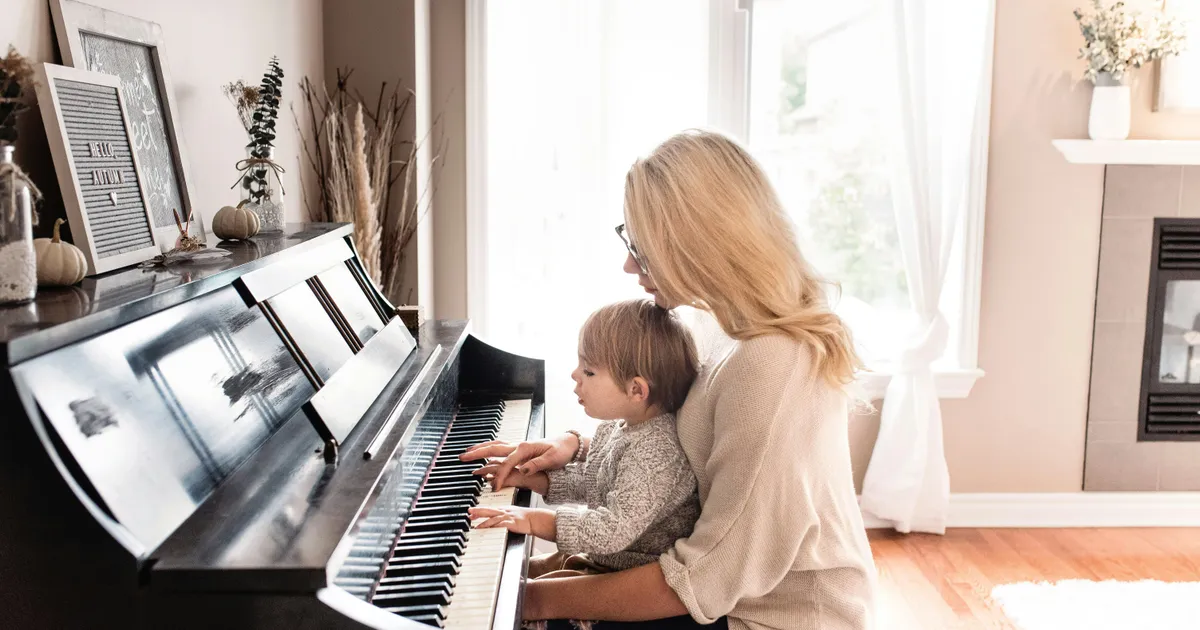

You can help your child practise piano without playing a note yourself. Your job isn’t to check whether the notes are right. It’s to keep the routine going, turn the teacher’s instructions into small tasks your child can finish, and be an interested audience. Leave the checking to the teacher, and to a tool that can hear the notes.
If you never learned an instrument, the practice slot can feel like a closed door. You hear something, you can’t tell whether it’s right, and “that sounded lovely” starts to feel like a guess. I learned piano as an adult, and I build SightReader, a sight-reading practice app. This is the guide I’d give a friend who’s paying for lessons and wondering what they’re supposed to do between them.
You don’t need to play to be useful
One of the best-known British studies of young musicians found that the most successful children had the parents who were most involved in lessons and practice in the early years (Davidson, Howe, Moore and Sloboda, 1996). Involved is the important word. What helps a young learner is a grown-up who turns up, keeps the routine and cares how it’s going. You can do all three without reading music.
The things you can’t do, like hearing a wrong note, fixing a wrist or explaining a dotted rhythm, belong to the teacher. Trying to do them anyway tends to backfire. A parent calling out corrections they aren’t sure of teaches a child to wait for the grown-up instead of reading the page.
The four jobs you can do without reading music
| Job | What it looks like | What it isn’t |
|---|---|---|
| Keeper of the routine | The same time, most days, kept short | Standing over a timer |
| Translator | Turning the teacher’s notes into today’s task | Teaching the piece yourself |
| Audience | Listening, asking questions, noticing effort | Spotting wrong notes |
| Messenger | Telling the teacher what was hard this week | Rewriting the teacher’s plan |
The rest of this post is how to do each one well.
Start with the teacher’s notebook
Most teachers write the week’s work in a notebook or send it by message. That note is your script, so make sure you get one:
- Ask for the week in writing. If the teacher doesn’t already write it down, ask for three lines: what to practise, how, and what “done” looks like.
- Catch the last five minutes of the lesson, or ask at pick-up: “What are the three things for this week?” It takes a minute and saves a week of guessing.
- Ask for bar numbers. If they aren’t printed in the music, ask the teacher to pencil them in. “Bars 5–8” then means the same thing to you, your child and the teacher.
- Ask for a model. A 20-second phone video of the teacher playing the tricky passage gives your child something to copy, and gives you something to compare against.
Turn “practise the left hand” into a task you can check
Teachers write in shorthand because the lesson is fresh in their minds. By Thursday, “practise the left hand” is a fog to a seven-year-old. Your most valuable job is to turn each line into a task with three parts: where (which bars), what (which hand, how slowly, counting or not) and how many (a number of times, or a point at which it’s done).
| The notebook says | Today’s task |
|---|---|
| Practise the left hand | Left hand alone, bars 5–8, slowly, three times. Then both hands once. |
| Learn the new piece | Just the first line today. The second line tomorrow. |
| Work on your scales | C major, right hand then left, until it’s right twice in a row. |
| Count carefully | Clap and count bars 1–4 out loud before playing them. |
| Polish the piece | Play it through once without stopping, whatever happens. |
The test of a good task is that you can tell whether it happened without reading music. Did they play bars 5–8? Three times? Out loud? Did they keep going after a slip? Anyone can see those things.
Small and focused also happens to be how good practice works. In a study of pianists, how they practised predicted how well they played, while the total time they spent practising did not (Williamon and Valentine, 2000). Five minutes on bars 5–8 does more than three play-throughs of the whole piece with the same stumble in the same place each time.
Let your child teach you
This is the trick most non-playing parents enjoy most. Ask your child to be the teacher:
- “Show me where middle C is.”
- “What are the names of the notes in the first bar?”
- “What does that squiggle mean?”
- “Teach me the first two bars, one finger is fine.”
Explaining something forces your child to check that they actually know it, and it puts them in the expert’s seat at a stage where most things about piano feel hard. If they can’t explain a sign or a note, that isn’t a failure. It’s a useful line for the notebook: “Not sure what the dots after the notes mean.”
Some parents go further and learn alongside their child. That can be fun, but it isn’t needed. Being taught for five minutes a week gives you most of the benefit.
What to say while you listen
You’re the audience, and audiences don’t mark. A few swaps that keep it encouraging without pretending:
| Instead of | Try |
|---|---|
| “That sounded wrong.” | “Which bit was hardest today?” |
| “Is that right?” | “Did that match what your teacher played?” |
| “Play it again properly.” | “Play me the bit you’re proudest of.” |
| “Well done!” (every time) | “You kept going after that slip. That’s the hard part.” |
| Calling out note names | Pointing at the bar and waiting |
Specific praise for effort and for keeping going is more believable than general praise, and it rewards the habits that actually build skill.
A simple week that works
Five or six short sessions beat one long one, partly because a skill settles in overnight. In one study, musicians learning a short passage on a keyboard only got more accurate when their practice sessions were a day apart, with a night’s sleep in between (Simmons, 2011). You don’t have to plan every day, but a shape helps:
| Day | Your child | You |
|---|---|---|
| Lesson day | Tells you one thing they learned | Get the week’s tasks in writing |
| The day after | The most important session: instructions are fresh | Go through the notebook together |
| Days 3–5 | One or two tasks each day, then something they enjoy | Be the audience for the last few minutes |
| Day 6 | A mini-concert of the week’s work | Ask what to tell the teacher |
| Day 7 | Rest, or free play | Nothing |
For most young beginners, 10 to 15 minutes a session is plenty. Older children and higher grades need longer, and the teacher is the best guide to how much. If you want to add a couple of minutes of reading brand-new music each day, I’ve written a separate guide to teaching a child piano sight reading.
When you can’t tell if it’s right
Sometimes your child will look at you and ask, “Was that right?” and you won’t know. That’s fine. You have options that don’t involve guessing:
- Compare with the teacher’s recording, if you have one.
- Hand the question back. “What do you think? Did it sound like your teacher’s?” Children often know.
- Write it down and let the teacher settle it at the next lesson.
- Use something that can hear the notes, which is where an app helps.
Where SightReader fits
This is the gap we built SightReader to fill: a parent who can keep the routine going but can’t judge the notes. Plug a digital piano or keyboard into a tablet or laptop with a USB cable, or let it listen through the microphone if you have an acoustic piano, and it marks every note as your child plays. With the metronome on, it checks the rhythm too. Each run ends with zero to three stars, so “how did it go?” has an answer you don’t have to make up.
It also fits the task-sized practice above. After a run, your child sees where it went wrong, and can practise just the hard bars or one hand at a time, which is “left hand, bars 5–8, three times” with something checking every note. Lessons take a child step by step from the very first note through the ABRSM grades, daily practice picks fresh music each day, and streaks and badges give them a reason to come back that isn’t you asking. If your child’s teacher uses SightReader too, they can set pieces with a due date and see how practice went.
The limits matter, so here they are. SightReader marks music that’s in SightReader, so it won’t check the pieces in your child’s lesson book unless that piece happens to be in the Library. It doesn’t teach hand position, posture or how to make a piece sound musical. That’s still the teacher’s job, and a good one is worth every lesson.
You can try it without an account in a couple of minutes. The free plan covers the early lessons and levels, and Pro opens the rest. If something would make practice at home easier for your family, email us at hello@sightreader.app. We read every message.
FAQ
Can I help my child with piano practice if I can’t play?
Yes. The most useful things a parent does at home have nothing to do with reading music: keeping a regular practice time, turning the teacher’s instructions into small tasks, listening with interest, and telling the teacher what was hard. Judging whether the notes are right is the teacher’s job, or the job of a tool that can hear them.
How do I know if my child is practising correctly?
Check what you can see rather than what you can hear. Did they work on the bars the teacher named, the number of times agreed, counting out loud if that was the task, and keep going after a slip? For the notes themselves, compare with a short recording from the teacher, or use an app that marks each note as it is played.
Should I sit with my child while they practise piano?
For young beginners, yes, for at least part of most sessions. Sit as an audience rather than a corrector: ask which bit was hardest, notice effort, and avoid calling out note names. As your child gets older and more independent, you can step back to checking in at the start and listening at the end.
Should I learn piano alongside my child?
Only if you want to. It can be fun and it helps you follow the lessons, but it isn’t needed. Asking your child to teach you a few notes or the first line of a piece gives most of the benefit: they have to put what they know into words, and they get to be the expert.
How long should a young beginner practise each day?
For most young beginners, 10 to 15 minutes on most days is plenty, and short sessions spread across the week work better than one long one. Older children and higher grades need longer. Ask the teacher what they expect, and set the session by tasks finished rather than minutes on the clock.
What should I do when my child gets stuck and I can’t help?
Write down exactly where they got stuck (the page and bar, and what went wrong if you can tell) and pass it to the teacher before the next lesson. Then move them on to a task they can do, so the session ends on something that went well. Being stuck on one bar for a week is normal and the teacher can usually fix it in minutes.