

Le grade initial, c’est la première fois qu’un test de déchiffrage te demande quelque chose qui ressemble à du concret. Le morceau ne fait que quatre mesures et les tonalités sont accueillantes, mais tu t’installes à un clavier inconnu, tu regardes une partition que tu n’as jamais vue, et là tu joues. La plupart des candidats ont passé des mois à s’approprier deux morceaux qu’ils connaissent par cœur, et on leur demande maintenant, le jour J, de lire un troisième morceau à froid.
C’est aussi le niveau où les bonnes habitudes coûtent peu à installer et cher à corriger plus tard. Si tu apprends au grade initial à compter à voix haute, à fixer la position de ta main avant de jouer et à lire les deux portées à la fois, tu auras un vrai avantage au grade 1, au grade 2 et à chaque grade ensuite. Si tu les sautes maintenant, chaque grade suivant sera plus difficile qu’il n’aurait à l’être.
Ce guide couvre ce qu’attendent les principaux jurys d’examen au grade initial, comment se préparer au test, et quelles partitions de SightReader se situent au bon niveau pour s’entraîner.
Ce qu’attendent les examinateurs au grade initial
Les jurys de grades de piano utilisés dans le monde sont plus d’accord que désaccord à ce niveau. Quel que soit le jury sous lequel tu passes, le test de déchiffrage du grade initial est très court, limité aux tonalités les plus basiques, maintenu dans une stricte position de cinq doigts avec les mains qui jouent séparément, et précédé d’une brève fenêtre de préparation pendant laquelle tu peux étudier la partition en silence ou en essayer des bouts au clavier. Le vocabulaire rythmique se limite aux blanches, noires, croches par paires et leurs silences équivalents. Les nuances sont les simples p et f, avec un phrasé en legato et staccato. Là où les jurys diffèrent, c’est surtout sur la longueur, sur le nom qu’ils donnent à ce niveau et sur le caractère obligatoire ou non du test.
| Jury | Longueur | Tonalités | Position de la main | Préparation | Obligatoire à ce niveau ? |
|---|---|---|---|---|---|
| ABRSM (R.-U.), « Initial Grade » | 4 mesures en 4/4 ; 6 en 2/4 | do majeur ; ré mineur | Chaque main séparément, 5 doigts de la tonique à la dominante | 30 secondes | Oui |
| Trinity (R.-U.), « Initial » | ~4 mesures | do majeur ; la mineur | 5 doigts, séparées | 30 secondes | Non, un des quatre tests de soutien au choix |
| LCM (R.-U.), « Step 1 / Step 2 / Pre-Prep » | Non évalué à ce niveau | s.o. | s.o. | s.o. | Pas de déchiffrage avant le grade 1 |
| RCM (Canada et É.-U.), « Preparatory A/B » | Très court | do, sol majeur | 5 doigts | Bref coup d’œil | Non, un des quatre tests de soutien au choix |
| MTAC Certificate of Merit (É.-U.), niveau 1 | Très court | do, sol majeur | 5 doigts | Bref coup d’œil | Oui |
| AMEB (Australie), « Preliminary » | Très court | do majeur | 5 doigts | Bref coup d’œil | Oui en Comprehensive ; au choix avec l’oral en Piano for Leisure |
Les libellés diffèrent, mais le test a la même forme, quand il existe. ABRSM est le plus explicite : il publie le nombre exact de mesures et le vocabulaire rythmique dans un programme public. Trinity et RCM te permettent tous deux d’éviter complètement le test de déchiffrage à ce niveau en choisissant d’autres tests de soutien (oral, improvisation, connaissances musicales), ce qui peut faire de l’un comme de l’autre le premier examen le plus doux pour un candidat qui n’a pas encore trouvé ses marques en déchiffrage. LCM n’évalue pas le déchiffrage à ses niveaux antérieurs au grade 1 (Pre-Prep, Step 1, Step 2). Il commence au grade 1 de LCM.
La forme du test est stable depuis des décennies, mais les longueurs exactes de mesures et les vocabulaires rythmiques sont révisés d’un cycle de programme à l’autre, dans des bornes étroites. Consulte le programme en vigueur de ton jury avant de passer l’examen.
Comment travailler le déchiffrage au grade initial
Le travail qui construit un déchiffreur sûr de lui au grade initial n’est pas le travail qui apprend un morceau. Le déchiffrage est une compétence distincte du fait de jouer une musique que tu connais déjà, et il appelle un autre type de séance. Si tu as lu notre guide principal pour progresser en déchiffrage, une partie de tout ça te semblera familière. Les points propres au grade initial sont ci-dessous.
Compte à voix haute, à chaque fois. C’est l’habitude la plus importante du grade initial, et la plus facile à zapper. À tempo lent, avec seulement des noires et des blanches, compter à voix haute n’est pas encore difficile. La voix garde une pulsation vivante pendant que l’œil fait le travail dur, et elle construit la mémoire musculaire dont tu auras besoin au grade 4 en 6/8 et au grade 6 en 5/4. Si tu n’arrives pas à compter à voix haute au grade initial, tu n’y arriveras pas au grade 5, et la musique s’effondrera.
Fixe la position de la main avant de jouer. Le grade initial garde chaque main dans une position de cinq doigts, de la tonique à la dominante. Pose tes mains sur les cinq bonnes notes avant de commencer, et vérifie-les. L’erreur la plus fréquente au grade initial, c’est de démarrer à la mauvaise octave ou avec le mauvais pouce. Deux secondes de préparation évitent les deux.
Lis les deux portées à la fois. C’est la grande compétence nouvelle du grade initial. Avant ça, la plupart des débutants lisent une portée à la fois, souvent la clé de sol d’abord, puis la clé de fa. À partir du grade initial, l’œil doit saisir les deux portées comme un tout. Travaille ça en jouant des morceaux courts délibérément lentement, en regardant la mesure comme une colonne verticale plutôt que comme deux lignes horizontales.
Ne t’arrête pas quand tu trébuches. Un test de déchiffrage est une performance, pas une leçon. Si tu joues une fausse note, tu continues. L’examinateur écoute la forme du morceau, pas l’exactitude note à note. S’arrêter coûte plus de points que n’importe quelle fausse note. Commence à entraîner cette habitude maintenant, pendant que la musique est assez simple pour t’en remettre.
Travaille plus de morceaux, pas le même morceau plus de fois. Les pianistes qui déchiffrent bien sont ceux qui ont lu le plus de musiques différentes. Lire cinq fois le même morceau de huit mesures n’est plus du déchiffrage après la première lecture. Demain, choisis un autre morceau.
Prépare l’examen avec les leçons du grade initial de SightReader
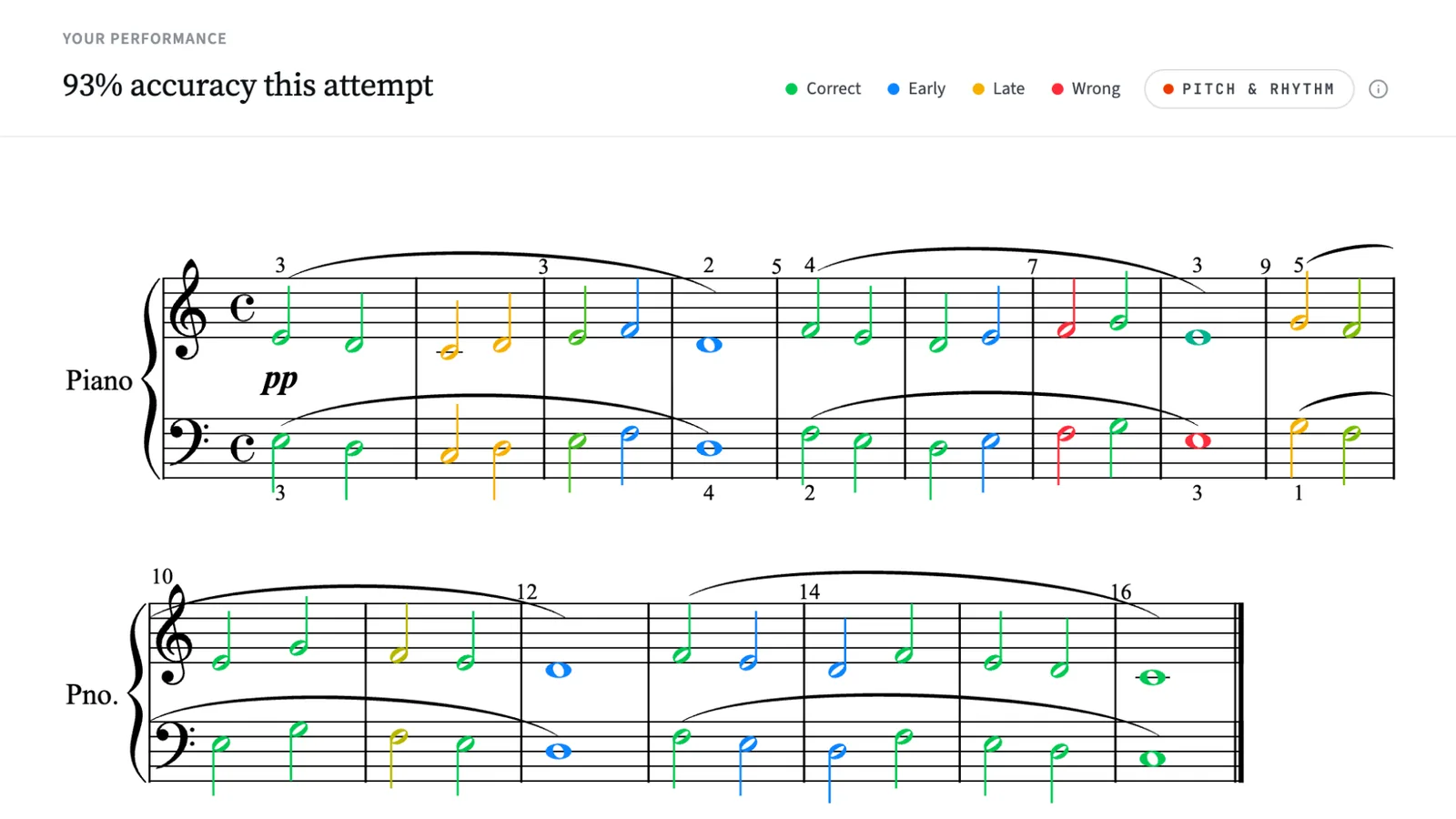
Les Leçons de SightReader t’accompagnent à travers le grade initial, une courte leçon à la fois, autour des mêmes contraintes que celles des examinateurs : do majeur et ré mineur, mains séparées, position de cinq doigts, rythmes simples. Chaque leçon enseigne une seule chose, puis te donne des morceaux de quelques mesures avec un retour instantané sur chaque note, donc tu apprends sur-le-champ quand la pulsation a dérapé ou que la mauvaise octave s’est glissée. Quand tu veux répéter, l’entraînement à l’examen du grade initial propose des morceaux gradués exactement à ce niveau.
Le jalon de préparation d’examen le plus concret que nous puissions recommander, c’est celui-ci : lis des morceaux du grade initial à 90 % de précision ou plus avant de passer l’examen. C’est le standard qu’un examinateur du grade initial qualifierait de sûr. Le grade initial est le socle sur lequel tout le reste se construit, donc il vaut le coup d’y revenir même après être passé au grade 1, surtout si ta lecture en do majeur se rouille.
Des partitions de la bibliothèque SightReader à lire à ce niveau
Les leçons du grade initial reposent sur du matériel de déchiffrage conçu sur mesure. La bibliothèque SightReader est l’autre versant de la plateforme : des milliers de vraies partitions de vrais compositeurs, étiquetées par difficulté. Les partitions marquées en difficulté 1 se situent dans la plage du grade initial au grade 1.
Le Sight Reading Book 1 de Christian Schäfer est la colonne vertébrale de la bibliothèque gratuite pour ce niveau. Les tout premiers exercices sont assez courts pour faire un seul déchiffrage, limités au do majeur et à des rythmes basiques, et commencent avec les mains qui bougent à l’identique avant d’introduire l’indépendance. De bons points de départ pour un déchiffreur de grade initial :
- L’exercice 1, c’est du mouvement par degré conjoint et par saut de tierce, les deux mains bougeant ensemble. Le plus petit entraînement de lecture possible.
- L’exercice 2 ajoute des sauts de quarte. À utiliser la deuxième fois que tu t’assieds avec le cahier.
- L’exercice 3 amène ensemble les sauts de tierce et de quarte, les mains toujours alignées.
- L’exercice 4 est le premier où les mains bougent différemment. Ralentis-le avant de le lire.
- L’exercice 5 prolonge l’exercice 4 avec une ligne plus longue et la même forme à mains indépendantes.
Traite chaque exercice comme un seul déchiffrage, puis passe au suivant. Si un morceau te semble trop facile, reste sur le niveau pour l’instant. Tout l’intérêt, c’est que les schémas que tu absorbes soient les bons.
Pièges courants au grade initial
Trois erreurs expliquent l’essentiel des points perdus à ce niveau.
La première, c’est de perdre le tempo entre les mesures. Les candidats comptent régulièrement à l’intérieur d’une mesure mais marquent une pause à chaque barre de mesure pour scruter la suivante. La pulsation meurt, et le morceau devient une série de fragments en forme de mesures. La solution, c’est de compter à voix haute à travers la barre de mesure, jamais en silence.
La deuxième, c’est de démarrer à la mauvaise octave ou avec le mauvais pouce. Le grade initial te donne explicitement la note de départ. Pose ta main avec soin avant de commencer, et revérifie l’octave. Une fois que tu as démarré, tu ne peux plus te repositionner.
La troisième, c’est d’oublier la portée de la clé de fa à mi-chemin. L’œil dérive vers la ligne de la clé de sol, la joue proprement, et la note grave ne vient jamais. Les examinateurs entendent immédiatement la note manquante. La solution, c’est de lire la mesure comme une colonne verticale avant de la jouer : chaque mesure a un haut et un bas, et les deux passent.
Avant ça, et la suite
- Avant ça : Rien. Le grade initial est le point d’entrée. Si tu n’as jamais passé d’examen de grade de piano, c’est le bon point de départ.
- La suite : Comment travailler le déchiffrage au piano au grade 1.
FAQ
Combien de temps faut-il travailler le déchiffrage au grade initial ?
Cinq minutes par jour, chaque jour, valent mieux qu’une demi-heure une fois par semaine. Au grade initial, la musique est assez courte pour que cinq minutes suffisent à deux ou trois déchiffrages complets d’un morceau nouveau. La compétence se consolide entre les séances, pas pendant.
Quel est l’équivalent du grade initial dans les autres jurys d’examen ?
Le grade initial correspond étroitement à Trinity Initial, LCM Step ou Pre-Grade 1, RCM Preparatory A ou B, aux niveaux les plus bas de MTAC et à AMEB Preliminary. Les libellés diffèrent, mais le format du test, non.
Quelles tonalités y a-t-il dans le test de déchiffrage du grade initial ?
Le grade initial d’ABRSM utilise do majeur et ré mineur. La plupart des autres jurys s’en tiennent au do majeur (et parfois au la mineur) au niveau équivalent. Tu ne rencontreras ni dièses ni bémols à l’armure au grade initial.
Comment me préparer au test le jour J ?
Tu as trente secondes (ABRSM, Trinity) ou soixante secondes (LCM) pour étudier le morceau avant de jouer. Sers-toi de ce temps. Vérifie la note de départ, le chiffrage de mesure et la forme de chaque mesure. Pose tes mains en silence sur le clavier avant de commencer, donne-toi le départ en comptant, et joue d’un bout à l’autre sans t’arrêter.
Combien de temps avant d’être prêt pour le grade 1 ?
Termine les leçons du grade initial, puis parcours l’entraînement à l’examen du grade initial. Si tu peux lire ces morceaux à 90 % de précision ou plus, sans t’arrêter, le matériel du grade 1 commence à être utile. Le grade 1 ajoute trois nouvelles tonalités, des altérations dans les tonalités mineures et une palette de nuances plus large, dont rien n’a de sens tant que les bases du grade initial ne sont pas fiables.
Sources
- ABRSM Piano Practical Grades Syllabus, spécifications de déchiffrage. https://www.abrsm.org/sites/default/files/2023-09/piano-2023-2024-practical-grades-syllabus-may-2022.pdf
- Trinity College London, guide des tests de soutien Initial. https://www.trinitycollege.com/qualifications/music/grade-exams/piano/piano-initial
- LCM Examinations, Music Grades Specification. https://lcme.uwl.ac.uk/media/jeelt5f4/music-grades-specification.pdf