

Le grade 2 est le niveau où le déchiffrage devient vraiment à deux mains. Jusqu’au grade 1 inclus, l’épreuve demande de jouer chaque main séparément, l’une après l’autre. À partir du grade 2, les mains jouent ensemble. C’est le grand changement, et il transforme presque tout dans la façon dont un candidat se prépare. Lire deux portées était déjà le défi à l’Initial. Lire deux portées tout en les jouant toutes les deux à la fois est une compétence différente, et c’est celle qui fait trébucher les candidats du grade 1 qui montent trop vite.
Rien d’autre ne change radicalement. Les tonalités sont celles que tu connais déjà, plus trois nouvelles. Les rythmes sont un peu plus riches, avec l’arrivée des figures pointées et des liaisons. La plage de nuances s’élargit d’un cran, avec l’arrivée du pp au grade 2. Aucun de ces ajouts ne constituerait à lui seul un vrai saut. Réunis, et combinés au jeu à deux mains, ils forment le programme à l’intérieur duquel la plupart des élèves de piano par grades apprennent à lire.
Ce guide couvre ce qu’attendent les principaux jurys d’examen au grade 2, comment préparer l’épreuve, et quels morceaux de SightReader se situent au bon niveau pour s’entraîner.
Ce qu’attendent les examinateurs au grade 2
Les jurys de piano par grades utilisés dans le monde s’accordent plus qu’ils ne divergent à ce niveau. Quel que soit le jury devant lequel tu passes, l’épreuve de déchiffrage du grade 2 est courte, limitée à un petit ensemble de tonalités comportant au plus un ou deux dièses ou bémols, jouée à deux mains ensemble, et précédée d’une brève fenêtre de préparation pendant laquelle tu peux étudier la musique en silence ou en essayer des passages au clavier. Le vocabulaire rythmique inclut désormais les figures pointées et les notes liées, et la plage de nuances couvre pp, p, mp, mf et f, avec des soufflets cresc. et dim.. Là où les jurys diffèrent, c’est surtout sur la longueur, les tonalités couvertes, le temps de préparation et le caractère obligatoire de l’épreuve.
| Jury | Longueur | Tonalités (cumulatives) | Position de la main | Prépa. | Obligatoire au grade 2 ? |
|---|---|---|---|---|---|
| ABRSM (Royaume-Uni) | 4 mesures en 3/4 ou 4/4 ; 6 en 2/4 | do, sol, fa, ré majeur ; la, ré, mi, sol mineur | 5 doigts, mains ensemble | 30 secondes | Oui |
| Trinity (Royaume-Uni) | ~4-6 mesures | do, sol, fa, ré majeur ; la mineur (le plus souvent) | 5 doigts, mains ensemble | 30 secondes | Non, l’une des quatre épreuves complémentaires au choix |
| LCM (Royaume-Uni) | Courte | do, sol, fa, ré majeur ; la, mi mineur | 5 doigts | 60 secondes | Oui |
| RCM (Canada et États-Unis) | Courte | do, sol, fa, ré majeur ; la, ré mineur | 5 doigts | Coup d’œil bref | Optionnelle aux niveaux 1-5 (l’une des quatre épreuves complémentaires au choix) ; obligatoire à partir du 6 |
| MTAC Certificate of Merit (États-Unis) | Courte | do, sol, fa majeur ; la mineur | 5 doigts | Coup d’œil bref | Oui |
| AMEB (Australie) | Courte | do, sol, fa, ré majeur ; la, ré mineur | 5 doigts | Coup d’œil bref | Oui en Comprehensive ; au choix avec l’oral en Piano for Leisure |
Quelques différences valent la peine d’être connues. Trinity, RCM et la filière Piano for Leisure de l’AMEB te permettent toutes d’éviter le déchiffrage au grade 2 en choisissant une autre épreuve complémentaire. Un candidat qui n’est pas encore à l’aise avec la lecture à deux mains peut donc contourner entièrement l’épreuve. LCM accorde une minute entière de préparation plutôt que trente secondes, ce qui récompense une passe de préparation active plutôt qu’un coup d’œil rapide. ABRSM publie les spécifications de grade 2 les plus explicites, et les données de la ligne ABRSM ci-dessus sont tirées directement du programme publié.
La forme de l’épreuve est stable depuis des décennies, mais la longueur exacte en mesures et le vocabulaire rythmique sont révisés d’un cycle de programme à l’autre, dans des marges étroites. Consulte le programme en vigueur de ton jury avant de passer l’examen.
Comment travailler le déchiffrage au grade 2
La plupart des conseils du grade 1 restent valables. Compte à voix haute, balaie le morceau avant de jouer, continue d’avancer quand tu trébuches. Les ajouts du grade 2 sont ci-dessous.
Lis les deux mains comme une seule colonne verticale. Au grade 1, tu pouvais t’en sortir en lisant la main droite et en suivant la gauche par en dessous. Au grade 2, avec les mains qui jouent ensemble, cette approche s’effondre. Entraîne-toi à voir chaque mesure comme une colonne. Identifie l’intervalle harmonique entre les mains au début de chaque temps, et laisse tes mains ressentir la forme ensemble.
Travaille le nouveau rythme pointé à part de la musique. La figure noire pointée et croche q. e est la source rythmique d’erreur la plus fréquente au grade 2. La plupart des candidats la connaissent intellectuellement, mais n’en ont pas intériorisé la sensation. Entraîne-toi à frapper le rythme contre une pulsation stable, les mains séparément sur une table, avant de lire le moindre morceau qui l’emploie.
Tiens les notes liées toute leur durée. Les notes liées sont nouvelles au grade 2 et piègent les candidats qui comptent par temps plutôt que par durée tenue. Si tu vois une noire liée à une blanche, le son dure trois temps et tu ne joues qu’une fois. Entraîne-toi à dire « joue et tiens et tiens » plutôt que « un deux trois ».
Ne laisse pas tomber les nuances de la main gauche. Les examinateurs écoutent l’équilibre dynamique entre les mains. L’erreur classique du grade 2 est de jouer la main droite à la nuance indiquée et la gauche à un mp plat, quoi qu’il arrive. Le remède : note la nuance de la main gauche pendant ton balayage et vérifie son volume dès le premier accord.
Reste dans la position des 5 doigts. Le grade 2 garde les mains en positions de cinq doigts, même si elles jouent désormais ensemble. Place les deux mains avec soin avant de commencer. Si ton pouce est sur la mauvaise note, tout ce qui suit sera faux.
Prépare l’examen avec les leçons du grade 2 de SightReader
Les Leçons de SightReader t’accompagnent à travers le grade 2, une courte leçon à la fois, autour des mêmes contraintes que celles des examinateurs, avec pour grande nouveauté la lecture à deux mains introduite pas à pas. Chaque leçon enseigne une seule chose, puis te donne de courts morceaux à lire avec un retour instantané sur chaque note. Les morceaux traversent les nouvelles tonalités (ré majeur, mi mineur, sol mineur) et ajoutent le nouveau vocabulaire rythmique et dynamique par petits pas délibérés. Quand tu veux répéter, l’entraînement à l’examen du grade 2 propose des morceaux gradués exactement à ce niveau.
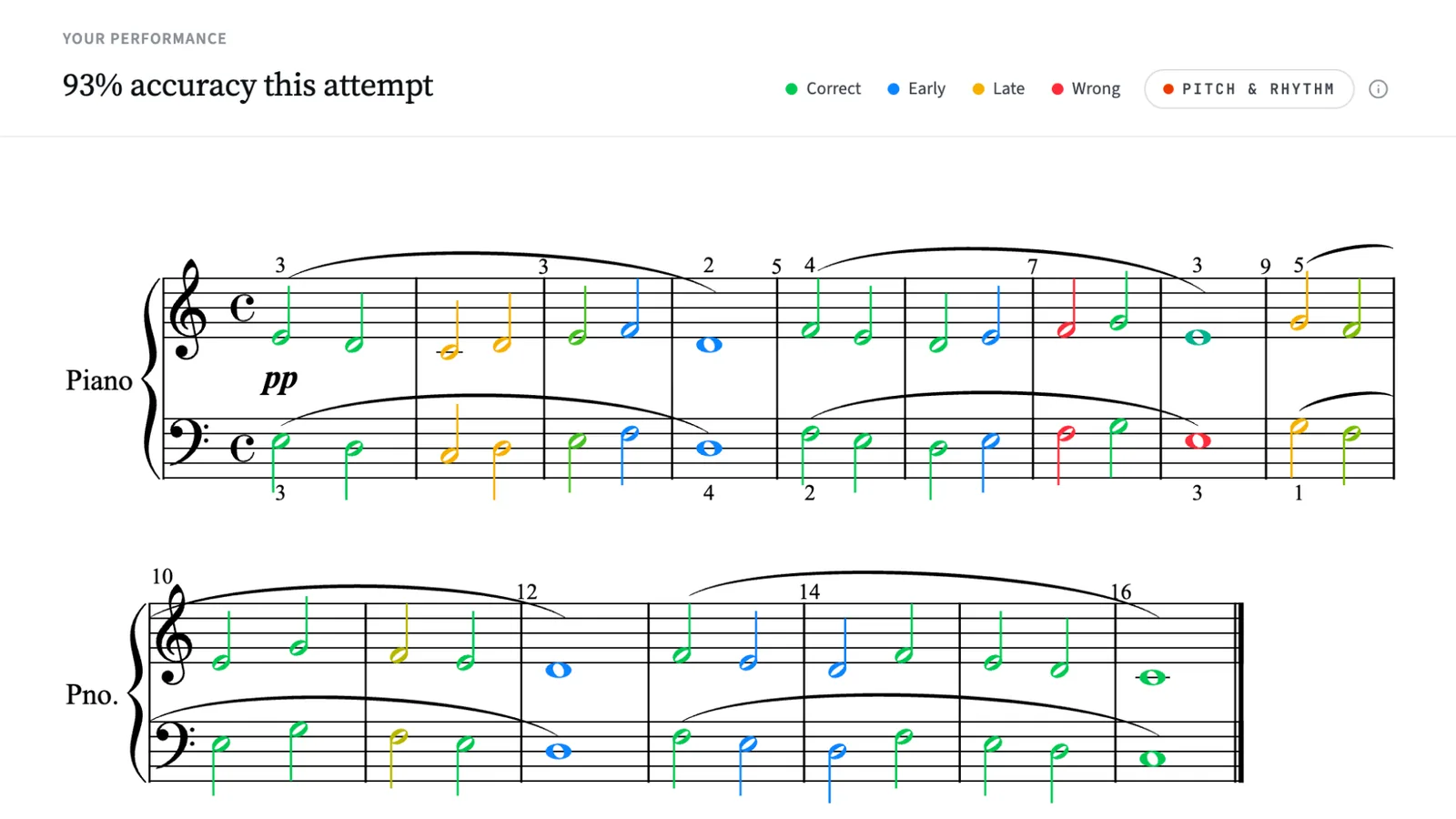
Le jalon de préparation le plus concret que nous puissions recommander est celui-ci : lis des morceaux du grade 2 à 90 % de précision ou plus avant de passer l’examen. C’est le niveau qu’un examinateur de grade 2 qualifierait d’assuré. Les tonalités ABRSM sont cumulatives, donc une fois le grade 2 devenu fiable, reviens à des morceaux de l’Initial et du grade 1 en do majeur, ré mineur et les tonalités du grade 1 pour les garder fraîches. Elles sont toujours dans le carnet de l’examinateur de grade 2.
Un second jalon, pour les candidats qui visent la mention : lis une série complète de morceaux d’entraînement du grade 2 sans descendre sous 75 % sur aucun d’eux. Cela élimine le profil « bons jours seulement » qui piège les candidats dont le travail est inégal d’une tonalité à l’autre.
Des morceaux de la bibliothèque SightReader à lire à ce niveau
La bibliothèque SightReader renferme des milliers de morceaux réels de compositeurs réels, étiquetés par difficulté. Les morceaux marqués en difficulté 2 se situent au niveau de déchiffrage du grade 2.
Le Sight Reading Book 1 de Christian Schäfer se poursuit en difficulté 2 avec des exercices qui introduisent le nouveau vocabulaire du grade 2 : jeu à deux mains en temps de valse, croches aux deux mains, et courtes mélodies en sol et en la. Quelques bons points de départ :
- L’exercice 18 est un jeu de parties en 3/4 (« temps de valse »). Ta première valse à deux mains du livre.
- L’exercice 20 introduit les croches aux deux mains. Sers-t’en pour travailler la nouvelle densité rythmique à tempo lent.
- L’exercice 28 est en sol majeur et utilise la même écriture de croches à deux mains. Bon pour garder la nouvelle tonalité à l’œil.
- L’exercice 31 est une courte mélodie en la. Un rappel utile que les armures de la mineur et de la majeur sont différentes, même quand les notes se ressemblent.
- L’exercice 32 est un jeu de parties complet pour les deux mains, en difficulté de grade 2. Garde-le pour la fin d’une séance, en guise d’auto-test.
Si un abonnement Pro entre en jeu, le catalogue de difficulté 2 s’ouvre aussi à de courts morceaux de Mozart, Hook, Türk, Reinagle, Beyer et d’autres. Utilise le filtre de difficulté de la bibliothèque pour les trouver, traite chacun comme un unique déchiffrage, et passe au suivant.
Pièges fréquents au grade 2
Trois erreurs concentrent l’essentiel des points perdus à ce niveau.
La première : manquer le rythme de la main gauche parce que l’œil est rivé sur la droite. La lecture à deux mains est nouvelle, et le réflexe naturel est de lire soigneusement la main droite en laissant la gauche se débrouiller. Elle ne le fera pas. Le remède est de balayer le rythme de la main gauche séparément pendant la fenêtre de préparation, avant de lire le morceau dans son ensemble.
La deuxième : relâcher les notes liées trop tôt. Les notes liées ressemblent à deux notes et sonnent comme une seule, longue. Les candidats qui comptent les temps plutôt que le son tenu ont tendance à rejouer la seconde note. Les examinateurs entendent aussitôt l’attaque indésirable.
La troisième : jouer le pp comme un p. La nuance pp est nouvelle au grade 2 et elle est nettement plus douce que p. Les candidats qui la traitent comme « un peu plus doux que d’habitude » perdent des points. Le remède est de jouer le pp à la limite de ton contrôle, assez doux pour que le piano ne parle presque pas.
Avant ça, et la suite
- Avant ça : Comment travailler le déchiffrage au piano au grade 1.
- La suite : Comment travailler le déchiffrage au piano au grade 3.
- La vue d’ensemble : Le guide ultime du déchiffrage au piano.
FAQ
Combien de temps faut-il travailler le déchiffrage au grade 2 ?
Cinq à dix minutes par jour, tous les jours. La lecture à deux mains fatigue l’œil et le cerveau à ce niveau, et les séances plus longues cessent d’être productives au bout d’un quart d’heure environ.
Quel est l’équivalent du grade 2 dans les autres jurys d’examen ?
Le grade 2 correspond étroitement au grade 2 de Trinity, au grade 2 de LCM, au grade 2 de l’AMEB et au niveau 2 du RCM. Le niveau 2 du MTAC Certificate of Merit est d’une difficulté comparable, avec la réserve que l’échelle du MTAC est un peu plus longue que celle d’ABRSM.
Qu’y a-t-il de nouveau au grade 2 par rapport au grade 1 ?
Le grand changement, c’est le jeu à deux mains. Les changements d’accompagnement sont trois nouvelles tonalités (ré majeur, mi mineur, sol mineur), l’ajout des rythmes pointés et des notes liées, et l’arrivée du pp dans la plage de nuances.
Les tonalités du grade 1 sont-elles encore à l’examen du grade 2 ?
Oui. Le grade 2 d’ABRSM est cumulatif : l’épreuve peut utiliser n’importe quelle tonalité de l’Initial, du grade 1 ou du grade 2. Il en va de même pour les chiffrages de mesure et le vocabulaire rythmique.
Combien de temps avant d’être prêt pour le grade 3 ?
Termine les leçons du grade 2, puis parcours l’entraînement à l’examen du grade 2. Si tu peux lire ces morceaux à 90 % de précision ou plus sans t’arrêter, et que tu peux en faire autant sur des morceaux du grade 1 et de l’Initial, tu es au niveau où le matériel de grade 3 commence à devenir utile. Le grade 3 sort tes mains de la position des 5 doigts et ajoute les accords de 2 notes, deux choses qui n’ont aucun sens tant que la lecture à deux mains n’est pas fiable.
Sources
- ABRSM Piano Practical Grades Syllabus, spécifications de déchiffrage. https://www.abrsm.org/sites/default/files/2023-09/piano-2023-2024-practical-grades-syllabus-may-2022.pdf
- Trinity College London, guide des épreuves complémentaires du grade 2. https://www.trinitycollege.com/qualifications/music/grade-exams/piano/piano-grade-2
- LCM Examinations, Music Grades Specification. https://lcme.uwl.ac.uk/media/jeelt5f4/music-grades-specification.pdf