

El grado 4 es el nivel en el que llega el compás compuesto. Hasta el grado 3 incluido, el mundo rítmico es sobre todo simple: dos, tres o cuatro tiempos por compás, cada uno divisible entre dos. A partir del grado 4 entra el 6/8 en el catálogo, y con él la diferencia entre contar seis corcheas y sentir dos tiempos de negra con puntillo. Los candidatos que aprenden a sentir el 6/8 navegan con soltura por el resto del programa. Los que no, se pasan los grados 4, 6 y 8 peleándose con el mismo problema disfrazado de formas distintas.
El grado 4 no añade tonalidades nuevas, lo que suena a tregua hasta que te fijas en lo que añade a cambio: anacrusas, notas de paso cromáticas, calderones, indicaciones de tenuto y la expectativa de que las leas todas a primera vista. Ahora los examinadores buscan forma musical, no solo notas correctas. El grado 4 es el primer grado en el que se evalúan en serio la forma dinámica y la articulación.
Esta guía cubre qué esperan los principales tribunales de examen en el grado 4, cómo prepararse para la prueba y qué piezas de SightReader están al nivel adecuado para practicar.
Qué esperan los examinadores en el grado 4
Los tribunales de grado de piano de todo el mundo coinciden más de lo que discrepan en este nivel. Sea cual sea el tribunal bajo el que te examines, la prueba de lectura a primera vista de grado 4 es corta, se toca con las dos manos juntas, queda fuera de la posición de cinco dedos y ahora usa compases compuestos además de los simples. El vocabulario rítmico arrastra todos los patrones anteriores y añade notas de paso cromáticas, anacrusa, calderones (U o fermata) e indicaciones de tenuto. El catálogo de tonalidades es el mismo que en el grado 3. Donde los tribunales difieren es sobre todo en la longitud, en lo que enfatizan y en si la prueba es obligatoria.
| Tribunal | Longitud | Tonalidades (acumulativas) | Compases (acumulativos) | Preparación | ¿Obligatoria en el grado 4? |
|---|---|---|---|---|---|
| ABRSM (Reino Unido) | unos 8 compases | do, sol, fa, re, la, si♭, mi♭ mayor; la, re, mi, sol, si menor | 2/4, 3/4, 4/4, 3/8, 6/8 | 30 segundos | Sí |
| Trinity (Reino Unido) | ~8 compases | Hasta 3 sostenidos o 3 bemoles | Simples y compuestos | 30 segundos | No, una de las cuatro pruebas de apoyo a elegir |
| LCM (Reino Unido) | Corta | Hasta 3 sostenidos o 3 bemoles | Simples y compuestos | 60 segundos | Sí |
| RCM (Canadá y EE. UU.) | Corta | Hasta 3 sostenidos o 3 bemoles | Simples y compuestos | Vistazo breve | Opcional en los niveles 1-5 (una de cuatro pruebas de apoyo a elegir); obligatoria a partir del 6 |
| MTAC Certificate of Merit (EE. UU.) | Corta | Hasta 3 sostenidos o 3 bemoles | Simples y compuestos | Vistazo breve | Sí |
| AMEB (Australia) | Corta | Hasta 3 sostenidos o 3 bemoles | Simples y compuestos | Vistazo breve | Sí en Comprehensive; a elegir con el oído en Piano for Leisure |
Vale la pena conocer algunas diferencias. Trinity, RCM y la modalidad Piano for Leisure de AMEB te permiten evitar la lectura a primera vista en el grado 4 eligiendo otra prueba de apoyo. LCM da un minuto completo de preparación, útil en un nivel en el que el 6/8 acaba de llegar y el candidato tiene que decidir entre contar en dos y contar en seis antes de tocar. ABRSM publica las especificaciones de grado 4 más explícitas, y los datos de la fila de ABRSM proceden directamente del programa publicado.
La forma de la prueba lleva décadas siendo estable, pero las longitudes exactas en compases y los vocabularios rítmicos se revisan de ciclo a ciclo del programa dentro de unos márgenes pequeños. Consulta el programa vigente de tu tribunal antes de presentarte al examen.
Cómo practicar la lectura a primera vista en el grado 4
Los consejos del grado 3 siguen valiendo: revisa primero la armadura, lee los intervalos como formas, planifica los cambios de posición de la mano. Lo que añade el grado 4 está abajo.
Siente el 6/8 en dos, no en seis. Este es el hábito más importante que hay que instalar en el grado 4. El compás contiene seis corcheas, pero el pulso son dos negras con puntillo. Si cuentas «uno dos tres cuatro cinco seis», la música sonará pesada y el tempo se desplomará en el compás más complicado. Dirige en dos mientras practicas. La mayoría de las piezas de grado 4 en 6/8 van a un tempo ágil, y la sensación de dos por compás es como lo consigues.
Busca la anacrusa. Una pieza que empieza con una anacrusa (una entrada en alzar o levare) te da un compás parcial antes del primer tiempo fuerte. Si cuentas desde el «1» en vez de desde la anacrusa, toda la pieza quedará desplazada un tiempo. Comprueba el primer compás. Si tiene menos tiempos de los que sugiere el compás, tienes una anacrusa. Cuéntate la entrada incluyendo el alzar.
Lee las notas de paso cromáticas como contorno, no como letras. El grado 4 introduce notas cromáticas entre dos notas estables. Leerlas por su nombre es demasiado lento. Leerlas como un «relleno» del hueco entre dos notas es rápido y preciso. Entrena esto tocando escalas cromáticas hasta que la forma visual de un paso cromático sea instantánea.
Decide de antemano qué harás ante un calderón. Un calderón (U o fermata) significa «sostener más de lo escrito». Cuánto más es un juicio que no puedes hacer al tempo de actuación. Decídelo de antemano: en torno a un tiempo extra de silencio, salvo que el contexto sugiera con fuerza otra cosa. Los examinadores quieren oír un calderón seguro, no uno confuso.
Vigila las dinámicas de forma activa. Los examinadores de grado 4 esperan forma dinámica, no solo notas correctas. El candidato que lee la música a un único volumen plano e ignora las indicaciones está perdiéndose el sentido de la prueba. Marca en tu revisión los compases más fuertes y más suaves y apunta hacia ellos deliberadamente.
Prepárate para el examen con las lecciones de grado 4 de SightReader
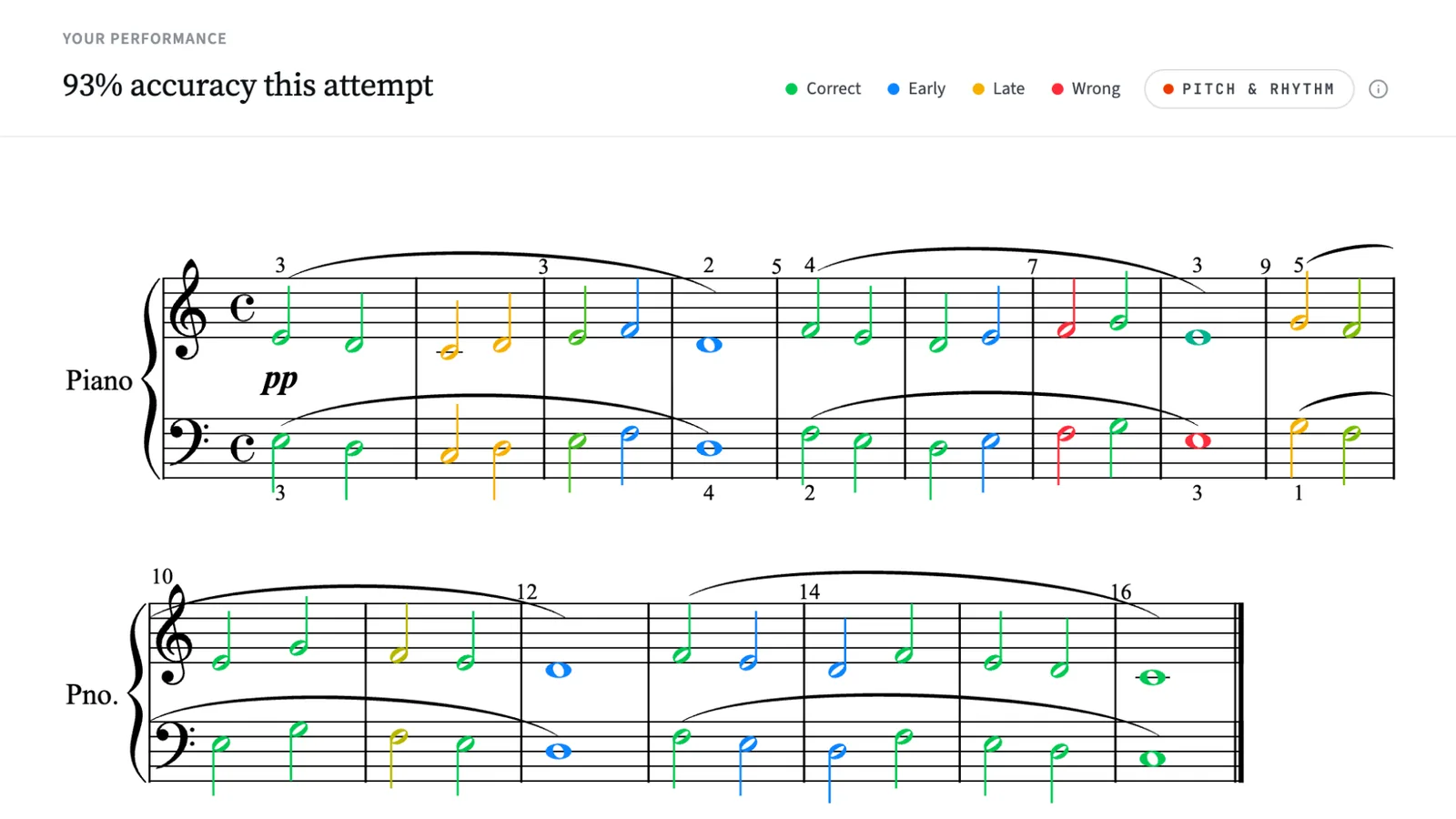
Las Lecciones de SightReader te llevan por el grado 4 lección a lección, en torno a las mismas restricciones que usan los examinadores, con el 6/8 introducido de forma metódica a través de piezas que se mueven con un pulso claro de dos por compás. Las lecciones también trabajan la anacrusa, las notas de paso cromáticas, los calderones y la forma dinámica más amplia que se espera en este nivel, y cada una te da piezas cortas para leer con feedback instantáneo en cada nota. Cuando quieras ensayar, la práctica de examen del grado 4 tiene piezas graduadas justo a este nivel.
El hito de preparación de examen más concreto que podemos recomendarte es este: lee piezas de grado 4 con un 90 % de precisión o más antes de presentarte al examen. Las tonalidades y el vocabulario rítmico de ABRSM son acumulativos, así que una vez que el grado 4 sea fiable, vuelve a piezas de los grados anteriores para mantenerlos al día.
Un segundo hito, para los candidatos que aspiran a la distinción: lee una serie completa de piezas de práctica de grado 4 sin bajar del 75 % en ninguna de ellas. La constancia entre los compases simples y compuestos es el indicador más fiable de una distinción en el grado 4.
Piezas de la biblioteca de SightReader para leer a este nivel
Explora la biblioteca de dificultad 4 para ver el catálogo de este nivel. Los compositores que verás con más frecuencia:
- Béla Bartók. Mikrokosmos, libros 2 y 3. La escritura de Bartók es un entrenamiento de grado 4 especialmente bueno por la mezcla de compases simples y compuestos y por las alteraciones modales que preparan el oído para el grado 5.
- Dmitri Kabalevsky. Piezas de los Op. 27 y Op. 39. Escritura de aula del siglo XX, amable de leer y rítmicamente variada.
- Friedrich Burgmüller. Números de dificultad media del Op. 100, los 25 estudios fáciles y progresivos. Las piezas de carácter dan a tu lectura a primera vista una melodía que seguir.
- Muzio Clementi. Las sonatinas más fáciles del Op. 36. Fraseo clásico, modulaciones suaves, escritura clara a dos manos.
- J. S. Bach. Las invenciones a dos voces más sencillas y una selección del Cuaderno de Anna Magdalena Bach. La escritura barroca a dos voces es ideal para la disciplina del ojo que el grado 4 exige.
Estas son de nivel Pro en nuestra biblioteca a esta dificultad. El filtro de dificultad de la biblioteca muestra lo que hay disponible. Las piezas marcadas con un candado requieren una suscripción Pro para tocarlas.
Errores frecuentes en el grado 4
Tres errores se llevan la mayoría de los puntos perdidos en este nivel.
El primero es ignorar por completo los cambios dinámicos. Los candidatos que leen con precisión a un único volumen plano suelen salir creyendo que lo han hecho bien. No es así. El grado 4 es el primer grado en el que los examinadores escuchan la forma dinámica como parte del baremo, y una pieza sin variación dinámica puntuará en la franja media aunque cada nota sea correcta.
El segundo es contar el 6/8 como seis corcheas. La pieza suena pesada y pedestre, y el candidato suele quedarse sin tiempo en los compases más fluidos. La solución es interiorizar la sensación de dos por compás del binario compuesto antes de leer en serio cualquier pieza en 6/8.
El tercero es perderse la anacrusa y empezar en un tiempo fuerte. La pieza queda entonces desfasada consigo misma un tiempo durante el resto de la prueba, y el candidato o lo oye y entra en pánico o sigue sin enterarse. En cualquier caso, el punto se pierde.
Antes de esto, y a continuación
- Antes de esto: Cómo practicar la lectura a primera vista al piano en el grado 3.
- A continuación: Cómo practicar la lectura a primera vista al piano en el grado 5.
- El panorama completo: La guía definitiva de la lectura a primera vista al piano.
Preguntas frecuentes
¿Cuánto debería practicar la lectura a primera vista en el grado 4?
Diez minutos al día, todos los días. El grado 4 es el primer grado en el que el vocabulario rítmico exige tiempo de práctica real para interiorizarse, y a las sesiones más cortas les cuesta cubrir tanto los compases simples como los compuestos de una sola sentada.
¿Cuál es el equivalente del grado 4 en otros tribunales de examen?
El grado 4 se corresponde de cerca con el grado 4 de Trinity, el grado 4 de LCM, el grado 4 de AMEB y el nivel 4 de RCM. El nivel 4 del MTAC Certificate of Merit tiene una dificultad comparable.
¿Qué hay de nuevo en el grado 4 respecto al grado 3?
El cambio principal es el 6/8, el primer compás compuesto del programa. Los cambios de apoyo son la anacrusa, las notas de paso cromáticas, los calderones y las indicaciones de tenuto. No hay tonalidades nuevas en el grado 4.
¿Cómo aprendo a sentir el 6/8?
Dirige en dos mientras tocas piezas en 6/8: un tiempo en la primera corchea de cada grupo de tres y otro en la cuarta corchea. Practica esto con el metrónomo puesto a dos clics por compás, no a seis. Tras una semana así, la sensación se vuelve automática.
¿Cuánto falta para que esté listo para el grado 5?
Termina las lecciones del grado 4 y luego lee la práctica de examen del grado 4. Si puedes leer esas piezas con un 90 % de precisión o más sin parar, y tu 6/8 te resulta tan natural como tu 4/4, el material de grado 5 empieza a ser útil. El grado 5 añade cuatro tonalidades nuevas y texturas de acordes a cuatro voces, lo que supone un salto mayor que el que fue el grado 4.
Fuentes
- ABRSM Piano Practical Grades Syllabus, especificaciones de lectura a primera vista. https://www.abrsm.org/sites/default/files/2023-09/piano-2023-2024-practical-grades-syllabus-may-2022.pdf
- Trinity College London, orientación sobre las pruebas de apoyo de grado 4. https://www.trinitycollege.com/qualifications/music/grade-exams/piano/piano-grade-4
- LCM Examinations, Music Grades Specification. https://lcme.uwl.ac.uk/media/jeelt5f4/music-grades-specification.pdf