

El grado 3 es el nivel en el que la lectura a primera vista deja de ser un ejercicio de cinco dedos. Por primera vez, la mano tiene que moverse. Verás un salto de sexta en mitad de un compás, un pasaje que sube fuera de la posición fija y vuelve a bajar, o un acorde que pide tu pulgar donde antes vivía el segundo dedo. La pieza sigue siendo corta, pero el ojo tiene más terreno que recorrer y la mano más decisiones que tomar.
En el grado 3 llegan tres tonalidades más, el ritmo gana dos nuevos ladrillos (acordes de dos notas y semicorcheas simples) y el 3/8 entra en el catálogo de compases. Ninguno de estos elementos por sí solo intimida. Apilados, hacen del grado 3 la primera prueba de lectura a primera vista en la que la preparación importa de verdad: la diferencia entre un candidato que escanea activamente y uno que solo echa un vistazo a la música es, de pronto, un grado entero en puntos.
Esta guía cubre qué esperan los principales tribunales de examen en el grado 3, cómo prepararse para la prueba y qué piezas de SightReader están al nivel adecuado para practicar.
Qué esperan los examinadores en el grado 3
Los tribunales de grados de piano que se usan por todo el mundo coinciden más de lo que difieren en este nivel. Sea cual sea el tribunal bajo el que te examines, la prueba de lectura a primera vista del grado 3 es corta, se toca con las dos manos a la vez y ahora permite que las manos se muevan fuera de la posición de cinco dedos que han mantenido desde el grado inicial. El vocabulario rítmico añade patrones simples de semicorcheas, y por primera vez aparece sobre la mesa un compás de 3/8. El rango dinámico no cambia respecto al grado 2 (de pp a f), con reguladores de cresc. y dim. y la nueva indicación de staccatissimo (ä). Donde difieren los tribunales es sobre todo en la longitud, la cobertura de tonalidades y si la prueba es obligatoria.
| Tribunal | Longitud | Tonalidades (nuevas en grado 3) | Posición de la mano | Preparación | ¿Obligatoria en el grado 3? |
|---|---|---|---|---|---|
| ABRSM (Reino Unido) | hasta 8 compases | la, si♭, mi♭ mayor; si menor (acumulativo, incluye los grados 0–2) | Fuera de los 5 dedos; acordes de 2 notas | 30 segundos | Sí |
| Trinity (Reino Unido) | ~6–8 compases | Sobre todo las tonalidades de grado 1–2 más la mayor | Fuera de los 5 dedos | 30 segundos | No, una de cuatro pruebas de apoyo a elegir |
| LCM (Reino Unido) | Corta | Hasta 2 sostenidos o 2 bemoles | Fuera de los 5 dedos | 60 segundos | Sí |
| RCM (Canadá y EE. UU.) | Corta | Hasta 2 sostenidos o 2 bemoles | Fuera de los 5 dedos | Vistazo breve | Opcional en los niveles 1–5 (una de cuatro pruebas de apoyo a elegir); obligatoria a partir del 6 |
| MTAC Certificate of Merit (EE. UU.) | Corta | do, sol, re, fa, si♭ mayor; la, mi menor | Fuera de los 5 dedos | Vistazo breve | Sí |
| AMEB (Australia) | Corta | Hasta 3 sostenidos o 3 bemoles | Fuera de los 5 dedos | Vistazo breve | Sí en Comprehensive; a elegir con el oído en Piano for Leisure |
Vale la pena conocer algunas diferencias. Trinity, RCM y la modalidad Piano for Leisure de AMEB te permiten evitar la lectura a primera vista en el grado 3 eligiendo otra prueba de apoyo. LCM da un minuto completo de preparación, lo cual en el grado 3 marca una diferencia real porque ahora hay más que escanear. ABRSM es el más explícito sobre sus parámetros, y los datos de la fila de ABRSM de arriba están tomados directamente del programa publicado.
La forma de la prueba lleva décadas estable, pero las longitudes exactas de los compases y los vocabularios rítmicos se revisan de ciclo a ciclo del programa dentro de unos márgenes pequeños. Consulta el programa vigente de tu tribunal antes de presentarte al examen.
Cómo practicar la lectura a primera vista en el grado 3
Los consejos del grado 2 siguen valiendo: cuenta en voz alta, lee las dos manos como una pila vertical, no pares cuando tropieces. Las novedades del grado 3 vienen abajo.
Escanea la armadura de clave en cada pieza. El grado 3 trae las primeras armaduras con dos o tres sostenidos o bemoles. El ojo que aprendió a leer en do mayor en el inicial pasará por alto una armadura de tres bemoles sin registrarla. Haz que la armadura sea lo primero que mires. Tararea en tu cabeza una escala de la tonalidad antes de empezar.
Lee los acordes de dos notas como formas, no como pilas. Una tercera parece dos notas en líneas que se tocan, una sexta, un hueco más ancho, y una octava es la más distinta visualmente de todas. En el grado 3 estos intervalos aparecen en cualquiera de las dos manos. Entrénate para reconocerlos como unidades. Do-mi es «una tercera en do», no «do más mi».
Marca el compás donde se mueve la mano. El grado 3 es el primer grado en el que la mano sale de la posición de cinco dedos. Busca ese compás en tu escaneo. La mayoría de los candidatos pierden puntos no porque la nueva posición sea difícil, sino porque no están listos para el movimiento cuando llega. Decide de antemano dónde va a aterrizar tu pulgar, y deja que el resto de la mano siga.
Practica el 3/8 por separado. Tres corcheas en un compás de 3/8 se sienten distintas de tres corcheas como tresillo dentro de un 2/4. El pulso es distinto, el patrón de dirección es distinto y el tempo lento de práctica es distinto. Trabaja el 3/8 como su propio compás en lugar de intentar deducirlo de ritmos que ya conoces.
Subdivide las semicorcheas mentalmente. El grado 3 introduce patrones simples de semicorcheas. Cuenta «1-y-uno-y» en lugar de contar las cuatro notas por separado. La subdivisión te permite colocar cada semicorchea en su parte del tiempo, en vez de embutir cuatro notas en una suposición sobre la duración.
Prepárate para el examen con las lecciones del grado 3 de SightReader
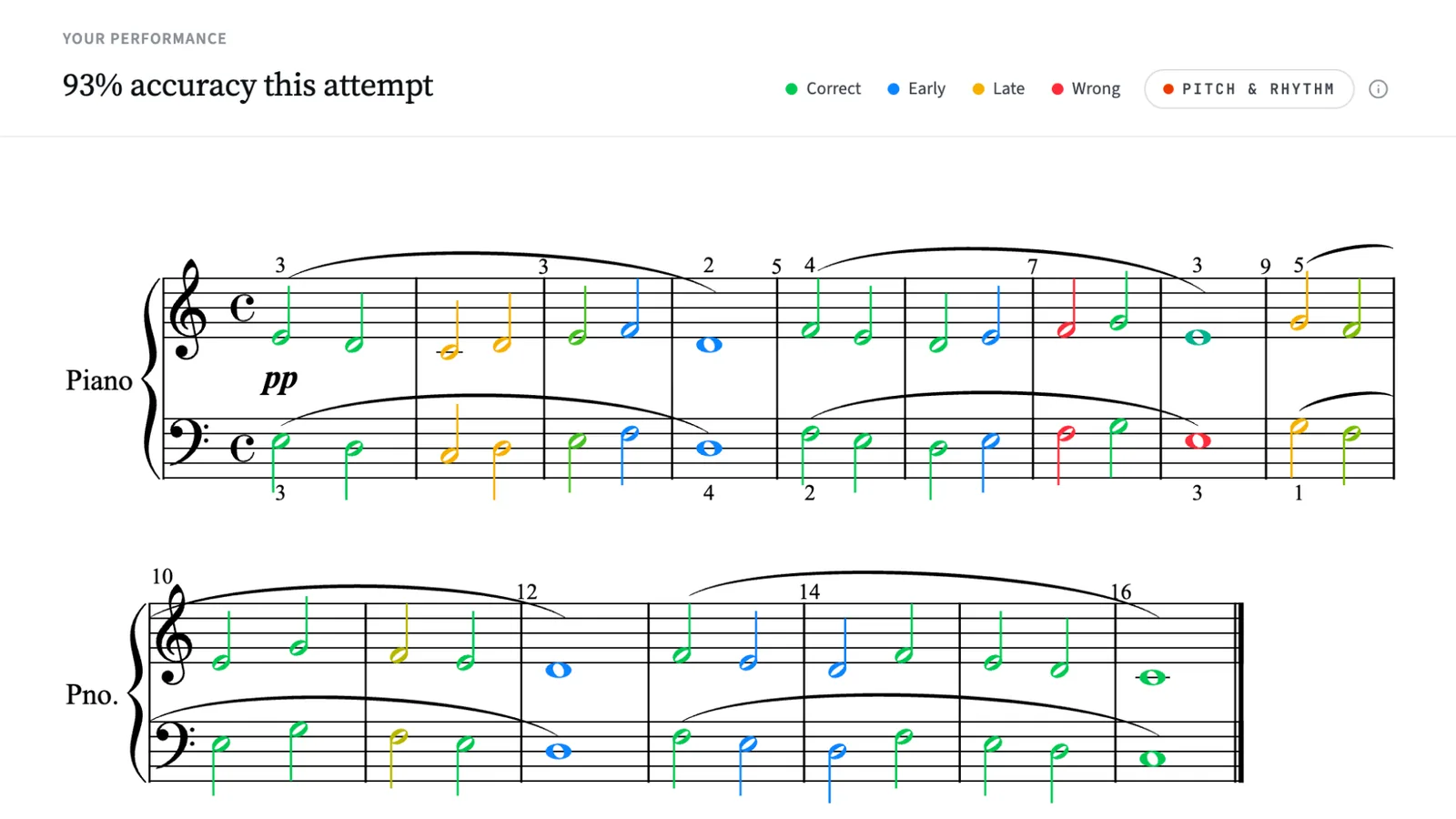
Las Lecciones de SightReader te llevan por el grado 3 lección a lección, en torno a las mismas restricciones que usan los examinadores: las tonalidades nuevas, los acordes de dos notas, los cambios de posición de la mano y el vocabulario rítmico que te encontrarás en el cuaderno de un examinador. Cada lección enseña una sola cosa y luego te da piezas cortas para leer con ella, con feedback instantáneo en cada nota, así que aprendes rápido qué intervalos o cambios no están saliendo. Cuando quieras ensayar, la práctica de examen del grado 3 tiene piezas graduadas justo a este nivel.
El hito de preparación de examen más concreto que podemos recomendar es este: lee piezas del grado 3 con un 90 % de precisión o más antes de presentarte al examen. Las tonalidades de ABRSM son acumulativas, así que una vez que el grado 3 sea fiable, vuelve a piezas del grado inicial, el grado 1 y el grado 2 en las tonalidades anteriores para mantenerlas frescas. Siguen estando en el cuaderno del examinador del grado 3.
Un segundo hito, para candidatos que aspiran a la distinción: lee una serie completa de piezas de práctica del grado 3 sin bajar del 75 % en ninguna de ellas. El grado 3 es el primer grado en el que la irregularidad entre tonalidades se le hace visible a un examinador, así que la consistencia importa más que el pico de rendimiento.
Piezas de la biblioteca de SightReader para leer a este nivel
Los ejercicios del Libro 1 de Christian Schäfer que te llevaron a través de los grados 1 y 2 ya no son el nivel adecuado. A partir del grado 3, el paso natural siguiente es la biblioteca de compositores más amplia, que está detrás de una membresía de SightReader Pro.
Explora la biblioteca de dificultad 3 para el catálogo de este nivel. Los compositores que verás con más frecuencia:
- Anton Diabelli. Sonatinas y piezas cortas diseñadas para el nivel de lectura a primera vista del grado 3, casi como si Diabelli las hubiera escrito para los examinadores. Escritura a dos manos, fraseo clásico, modulaciones suaves.
- Carl Czerny. Los primeros estudios de la Op. 599 y la Op. 821 están a este nivel. Útiles para el vocabulario rítmico y los cambios de posición de la mano.
- Friedrich Burgmüller. Los números más fáciles de la Op. 100 («25 estudios fáciles y progresivos»). Las melodías de Burgmüller son piezas de carácter, no ejercicios, lo que las hace más disfrutables de leer a primera vista.
- Béla Bartók. Mikrokosmos, libros 1 y 2. La escritura modal de Bartók es un entrenamiento excelente para leer alteraciones, que llegan en serio en el grado 3.
- J. S. Bach. Selecciones del Cuaderno de Anna Magdalena Bach. Escritura a dos voces, ornamentación barroca, tonalidades amables.
En nuestra biblioteca, estas son de nivel Pro a esta dificultad. El filtro de dificultad de la biblioteca muestra todo lo disponible. Las piezas marcadas con un candado requieren una membresía Pro para tocarlas.
Errores comunes en el grado 3
Tres errores explican la mayoría de los puntos perdidos en este nivel.
El primero es estrellarse contra un cambio de tonalidad. El candidato escanea el compás, fija el ritmo y empieza a tocar, pero nunca registró que la armadura tiene tres bemoles. A dos o tres compases, las notas equivocadas se acumulan y la prueba se viene abajo. La solución es mirar la armadura primero, siempre, y tocar una escala de la tonalidad en tu cabeza antes de empezar.
El segundo es tocar bien una nota de un acorde de dos notas y mal la otra. El oído escucha la nota consonante y pasa por alto la equivocada, pero el examinador oye las dos. La solución es leer los acordes de dos notas como intervalos con nombre (tercera, sexta, octava) y comprobar que las dos notas encajan con la armonía implícita del compás.
El tercero es tratar el 3/8 como un lento de 1 por compás. Los candidatos que aprendieron el 6/8 en otra parte (el 3/8 se suele introducir antes que el 6/8 en ABRSM) buscan un pulso compuesto donde no lo hay. El 3/8 son tres corcheas, un compás, a menudo a un tempo vivo. Fija el pulso a nivel de corchea antes de empezar.
Antes de esto, y a continuación
- Antes de esto: Cómo practicar la lectura a primera vista al piano en el grado 2.
- A continuación: Cómo practicar la lectura a primera vista al piano en el grado 4.
- El panorama completo: La guía definitiva de la lectura a primera vista al piano.
Preguntas frecuentes
¿Cuánto tiempo debería practicar la lectura a primera vista en el grado 3?
De cinco a diez minutos al día, todos los días. El grado 3 introduce más variables que cualquier grado anterior, así que la frecuencia importa más que la duración.
¿Cuál es el equivalente del grado 3 en otros tribunales de examen?
El grado 3 se corresponde de cerca con Trinity grado 3, LCM grado 3, AMEB grado 3 y RCM nivel 3. El MTAC Certificate of Merit nivel 3 tiene una dificultad comparable, aunque MTAC tiende a introducir los cambios de posición de la mano algo más tarde que ABRSM.
¿Qué hay de nuevo en el grado 3 respecto al grado 2?
Tres cosas nuevas: las manos se mueven fuera de la posición de cinco dedos por primera vez, aparecen acordes de dos notas en cualquiera de las dos manos y el 3/8 se une al catálogo de compases. Las tonalidades nuevas son la mayor, si♭ mayor, mi♭ mayor y si menor.
¿Cómo practico los nuevos acordes de dos notas?
Trabaja los intervalos por separado. Toca terceras, sextas, octavas y segundas en cada mano hasta que cada intervalo tenga una firma visual que reconozcas sin contar líneas y espacios. Luego lee piezas que los usen.
¿Cuánto falta para estar listo para el grado 4?
Termina las lecciones del grado 3 y luego lee la práctica de examen del grado 3. Si puedes leer esas piezas con un 90 % de precisión o más sin parar, y los grados anteriores siguen fiables cuando los compruebas al azar, el material del grado 4 empieza a ser útil. El grado 4 añade el 6/8, el primer compás compuesto del programa, que es un salto importante.
Fuentes
- ABRSM Piano Practical Grades Syllabus, especificaciones de lectura a primera vista. https://www.abrsm.org/sites/default/files/2023-09/piano-2023-2024-practical-grades-syllabus-may-2022.pdf
- Trinity College London, guía de pruebas de apoyo del grado 3. https://www.trinitycollege.com/qualifications/music/grade-exams/piano/piano-grade-3
- LCM Examinations, Music Grades Specification. https://lcme.uwl.ac.uk/media/jeelt5f4/music-grades-specification.pdf