

El grado 1 es el nivel en el que la lectura a primera vista se convierte por primera vez en una prueba de verdad, y no en una comprobación amable de que conoces las notas. La pieza que tienes que tocar es corta y las tonalidades son benévolas, pero la prueba va en serio. Te sientas al piano, te dan unos segundos para mirar y luego tocas. Tienes un solo intento, a un tempo constante, y sigues adelante aunque toques notas equivocadas.
También es el nivel donde más importan los buenos hábitos. La técnica que construyes ahora es la técnica que llevarás hasta el grado 8. Si aprendes a escanear una pieza antes de tocarla, a contar en voz alta y a seguir adelante cuando tropiezas, ya has aprendido las tres cosas que la mayoría de los lectores adultos a primera vista nunca aprenden. Si te las saltas ahora, pasarás los siguientes siete grados recuperando el tiempo perdido.
Esta guía cubre qué esperan los principales tribunales de examen en el grado 1, cómo prepararte para la prueba y qué piezas de SightReader se sitúan en el nivel adecuado para practicar.
Qué esperan los examinadores en el grado 1
Los tribunales de grado de piano que se usan por todo el mundo coinciden más de lo que discrepan a este nivel. Sea cual sea el tribunal bajo el que te examines, la prueba de lectura a primera vista de grado 1 es corta, se limita a un pequeño conjunto de tonalidades amables, se mantiene dentro de una posición de cinco dedos con las manos tocando por separado y va precedida de una breve ventana de preparación durante la cual puedes estudiar la música en silencio o probar partes de ella en el teclado. El vocabulario rítmico se limita a los valores que verías en un método típico de primer año, y el rango dinámico cubre p, mp, mf y f, con sencillas reguladoras de cresc. y dim.. Donde los tribunales difieren es sobre todo en la longitud, la cobertura de tonalidades, el tiempo de preparación y si la prueba es obligatoria.
| Tribunal | Longitud | Tonalidades | Posición de la mano | Alteraciones | Preparación | ¿Obligatoria en el grado 1? |
|---|---|---|---|---|---|---|
| ABRSM (Reino Unido) | 4 compases en 3/4 o 4/4; 6 en 2/4 | do, sol, fa mayor; la, re menor | Cualquiera de 5 dedos, separadas | Ocasionales (tonalidades menores) | 30 segundos | Sí |
| Trinity (Reino Unido) | ~4 compases | Sobre todo do y sol mayor | 5 dedos, separadas | Raras | 30 segundos | No, una de cuatro pruebas de apoyo a elegir |
| LCM (Reino Unido) | Corta | do, sol, fa mayor | 5 dedos | Raras | 60 segundos | Sí |
| RCM (Canadá y EE. UU.) | Corta | do, sol mayor | 5 dedos | Raras | Vistazo breve | Opcional en los niveles 1-5 (una de cuatro pruebas de apoyo a elegir); obligatoria a partir de 6 |
| MTAC Certificate of Merit (EE. UU.) | Corta | do, sol mayor | 5 dedos | Raras | Vistazo breve | Sí |
| AMEB (Australia) | Corta | do, sol, fa mayor | 5 dedos | Raras | Vistazo breve | Sí en Comprehensive; se elige con el oído en Piano for Leisure |
Vale la pena conocer algunas de las diferencias. Trinity, RCM y la modalidad Piano for Leisure de AMEB te permiten evitar la lectura a primera vista en el grado 1 eligiendo una prueba de apoyo distinta (oído, improvisación o conocimientos musicales, según el tribunal), de modo que un candidato que aún no se ha asentado en la lectura a primera vista puede rodear la prueba por completo. LCM da un minuto entero de preparación en lugar de treinta segundos, lo que recompensa un enfoque de práctica algo distinto en el que la ventana de preparación se usa de forma activa y no como un rápido vistazo visual. ABRSM es el más explícito sobre sus parámetros, y publica las longitudes, tonalidades y vocabulario rítmico exactos en un programa público que se actualiza cada dos años.
La forma de la prueba se ha mantenido estable durante décadas, pero las longitudes exactas de los compases y los vocabularios rítmicos se revisan de un ciclo de programa a otro dentro de unos márgenes pequeños. Consulta el programa actual de tu tribunal antes de presentarte al examen.
Cómo practicar la lectura a primera vista en el grado 1
La práctica que forma a un lector a primera vista seguro en el grado 1 no es la práctica que aprende una pieza. La lectura a primera vista es una habilidad distinta de tocar música que ya conoces, y pide un tipo de sesión distinto. Si has leído nuestra guía principal sobre cómo mejorar la lectura a primera vista, parte de esto te sonará. Los puntos específicos del grado están abajo.
Lee en bloques de dos notas, no de una. En el grado 1 cada intervalo es pequeño y los patrones son sencillos. Entrénate para ver grados conjuntos y saltos como formas y no como notas sueltas. Do-mi-sol es un acorde, no tres letras. Do-re-mi-fa-sol es una escala, no cinco letras. Tu mano debería sentir la forma antes de que tu mente consciente la nombre.
Escanea antes de tocar. Antes del primer tiempo, mira la armadura, el compás, la nota inicial, la nota más aguda y la más grave. Son cinco cosas, y en el grado 1 sí tienes tiempo de comprobar las cinco en la ventana de preparación. La mayoría de las notas equivocadas a este nivel vienen de candidatos que empezaron a tocar antes de haber localizado su mano de partida.
Cuenta en voz alta, incluso en el examen. Los examinadores no penalizan contar en voz baja. Sí penalizan pararse. La voz mantiene vivo el pulso mientras los ojos hacen el trabajo difícil, y los ritmos del grado 1 son lo bastante sencillos como para que contar en voz alta no sea aún un trabalenguas. Construye el hábito ahora que no te cuesta nada.
Practica al nivel inferior al de tus piezas de clase. Este es el consejo que repite todo profesor de lectura a primera vista y que todo alumno adulto ignora. Si en clase trabajas piezas de grado 2, lee a primera vista material de grado 1. Si tus piezas son de grado 1, lee a primera vista grado Initial. La franja de precisión donde aprendes está más o menos entre el setenta y el ochenta por ciento de aciertos. Leer a primera vista al nivel que ya tocas puntúa demasiado alto. Leer a primera vista por encima te enseña a entrar en pánico.
No pares cuando tropieces. Una prueba de lectura a primera vista es una actuación, no una clase. Si tocas una nota equivocada, sigues adelante. Practica eso. Pon un metrónomo a un tempo lento, toca de principio a fin una pieza corta que no hayas visto nunca y prohíbete volver atrás. Las primeras veces te sentirás fatal. Después de una semana deja de sentirse fatal. Después de un mes es la única forma en que lees.
Prepárate para el examen con las lecciones de grado 1 de SightReader
Las Lecciones de SightReader te llevan por el grado 1 lección a lección, diseñadas en torno a las mismas restricciones que usan los examinadores. Seguimos el modelo de ABRSM: el grado Initial te da do mayor y re menor, y el grado 1 lo amplía con sol mayor, fa mayor y la menor. Cada lección enseña una sola cosa y luego te da piezas cortas para leer con ella, con feedback instantáneo en cada nota. Cuando quieras ensayar, la práctica de examen del grado 1 tiene piezas graduadas justo a este nivel. La lectura a primera vista del grado 1 de ABRSM cubre las cinco tonalidades de forma acumulativa, así que cuando el grado 1 sea fiable, conviene volver a piezas del grado Initial en do mayor y re menor para mantener frescas esas tonalidades.
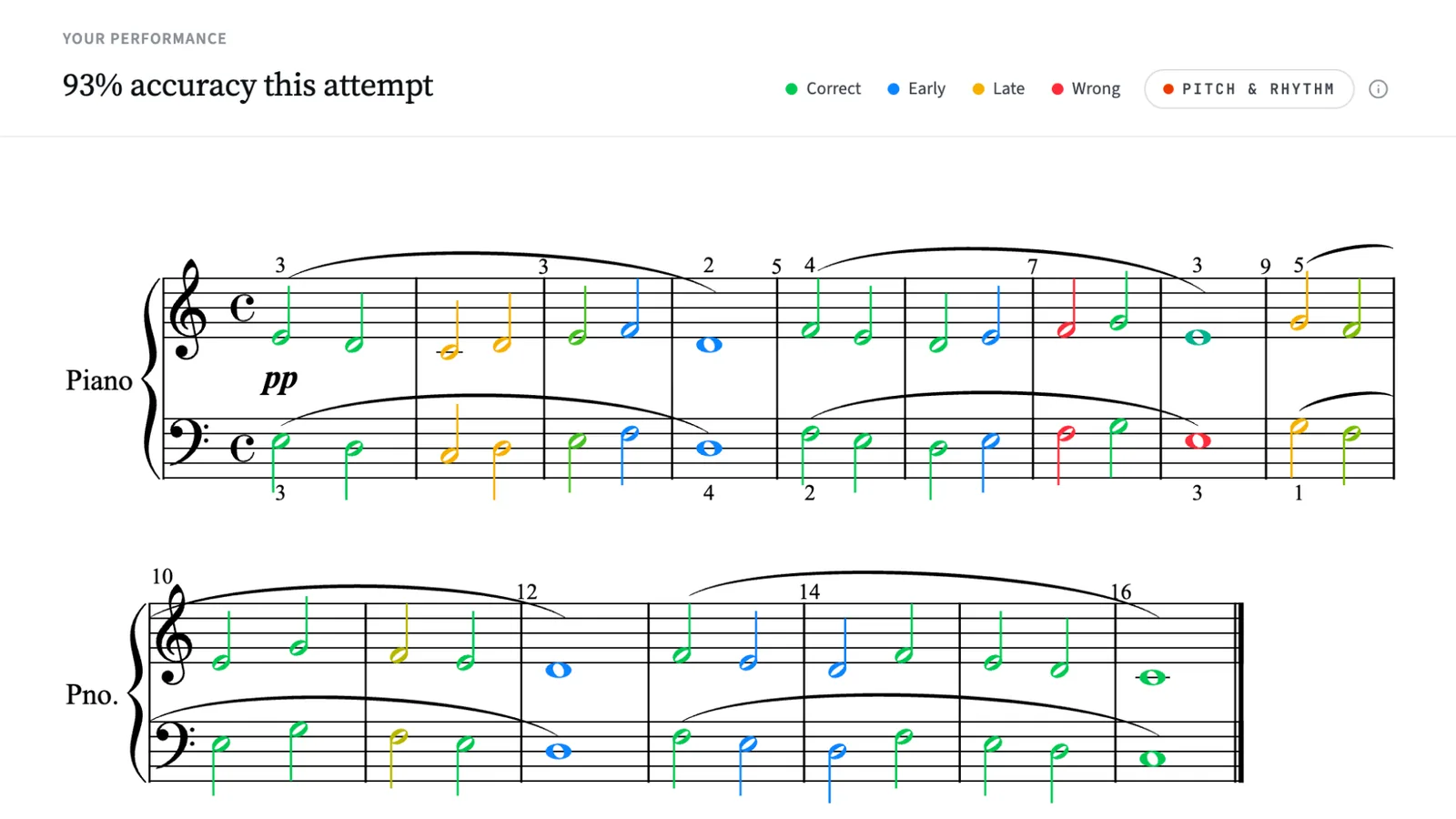
El hito de preparación de examen más concreto que podemos recomendarte es este: lee piezas de grado 1 con un 90 % de precisión o más antes de presentarte al examen. Ese es el estándar que un examinador de grado 1 llamaría seguro, y el feedback guiado por el cursor de SightReader hace fácil ver dónde estás por debajo de la línea. Si puedes leerlas al 90 % sin paradas, la prueba del día será más pequeña que lo que has estado practicando.
Un segundo hito, para quienes aspiran a la distinción: lee una serie completa de piezas de práctica de grado 1 sin bajar del 75 % en ninguna de ellas. Esto filtra el patrón de «solo los días buenos» que atrapa a muchos candidatos cuya práctica es desigual entre tonalidades.
Piezas de la biblioteca de SightReader para leer a este nivel
Las lecciones de grado 1 de arriba son material de lectura a primera vista hecho a propósito. La biblioteca de SightReader es la otra cara de la plataforma: miles de piezas reales de compositores reales, etiquetadas por dificultad. Las piezas marcadas con dificultad 1 se sitúan en el nivel de lectura a primera vista del grado 1.
El Sight Reading Book 1 de Christian Schäfer es la columna vertebral de la biblioteca gratuita para este nivel. Diecisiete ejercicios numerados que avanzan por patrones de lectura concretos, cada uno lo bastante corto como para ser una sola lectura a primera vista. Unos cuantos buenos puntos de partida:
- El Ejercicio 1 ejercita el movimiento por grado conjunto y por salto de tercera, con las manos moviéndose juntas. El entrenamiento de lectura más pequeño posible.
- El Ejercicio 4 es el primero en el que las manos se mueven de forma distinta. Úsalo para practicar la lectura de dos pentagramas a la vez en lugar de leer uno y copiarlo.
- El Ejercicio 6 introduce una armadura: fa♯ para el tercer dedo de cada mano. El primer punto del libro donde el ojo tiene que recordar una alteración de un compás a otro.
- El Ejercicio 16 incorpora silencios de negra y alteraciones. Útil como sesión de estiramiento una vez que los ejercicios anteriores se sientan ligeros.
Si tienes una cuenta de SightReader Pro, se abre el resto del catálogo de dificultad 1: piezas cortas de Mozart, Hook, Debussy, Tielman Susato y otros. Usa el filtro de dificultad de la biblioteca para encontrarlas, trata cada una como una sola lectura a primera vista y pasa a la siguiente. Esa es la práctica que construye la habilidad, no tocarlas diez veces cada una hasta memorizarlas.
Errores habituales en el grado 1
Tres errores explican la mayor parte de los puntos que se pierden a este nivel.
El primero es olvidar la armadura después del primer compás. El grado 1 solo tiene un sostenido o un bemol, pero los candidatos suelen tocar el sostenido una vez y luego olvidarlo a partir del segundo compás. La solución es rodear la armadura con la mirada durante la ventana de preparación y recorrer mentalmente los primeros compases, oyendo en contexto la nota alterada antes de empezar.
El segundo es pararse en la primera nota equivocada. Los examinadores quieren oír la pieza, no las correcciones. Una nota equivocada te cuesta una fracción de punto. Pararte te cuesta varios. Si te paras más de una vez, la prueba está prácticamente acabada. El modelo mental que hay que tener es que una prueba de lectura a primera vista está más cerca de una actuación que de una clase.
El tercero es tocar demasiado rápido. El tempo indicado es una guía, y la mayoría de los candidatos de grado 1 puntuarían más alto si tocaran a tres cuartos del tempo impreso arriba. No hay bonificación por velocidad a este nivel. Sí hay una gran penalización por los tropiezos.
Antes de esto, y lo que viene después
- Antes de esto: Cómo practicar la lectura a primera vista al piano en el grado Initial, para quienes aún no se han presentado a un examen con grado.
- Lo que viene después: Cómo practicar la lectura a primera vista al piano en el grado 2, para quienes avanzan desde el grado 1.
Preguntas frecuentes
¿Cuánto tiempo debería practicar la lectura a primera vista en el grado 1?
Cinco minutos al día, todos los días, le ganan a media hora una vez por semana. La habilidad se consolida entre sesiones, no dentro de ellas. Si solo puedes practicar tres o cuatro veces por semana, las sesiones de diez minutos están bien. Cualquier cosa de más de quince minutos de una sentada está desperdiciada a este nivel.
¿Cuál es el equivalente del grado 1 en otros tribunales de examen?
El grado 1 se corresponde muy de cerca entre ABRSM, Trinity, LCM y AMEB grado 1 en el Reino Unido y Australia. Los equivalentes más cercanos en Norteamérica son el RCM Level 1 (el Certificate Program del Royal Conservatory, muy usado en Canadá y EE. UU.) y el MTAC Certificate of Merit Level 1 en California. Tanto RCM como MTAC tienen escalas más largas que ABRSM (el Level 10 de RCM es más o menos el grado 8 de ABRSM), así que el mismo número de nivel se siente un poco más fácil en el lado de RCM y MTAC en la parte baja de la escala. Muévete entre cualquiera de ellos y la habilidad del día es la misma.
¿Qué tonalidades hay en la prueba de lectura a primera vista del grado 1?
La lectura a primera vista del grado 1 de ABRSM cubre cinco tonalidades de forma acumulativa: do mayor, sol mayor y fa mayor, más la menor y re menor. Las tonalidades menores pueden incluir alteraciones ocasionales, pero las mayores normalmente no. El grado 1 de Trinity se apoya en do y sol mayor y usa las tonalidades menores con más moderación que ABRSM. El grado 1 de LCM, RCM y AMEB se sitúa cerca de ABRSM en alcance, aunque la mayoría de los candidatos solo se encontrará con dos o tres de las tonalidades en cualquier prueba concreta.
¿Cómo me preparo para la prueba el día del examen?
Tienes treinta segundos (ABRSM, Trinity) o sesenta segundos (LCM) para estudiar la pieza antes de tocar. Usa ese tiempo. Comprueba la armadura, el compás, la nota inicial y la forma general de la pieza. Si el tribunal lo permite, toca el compás más difícil en silencio o en voz alta. Luego fija la pulsación en tu cabeza, cuéntate la entrada y empieza.
¿Cuánto falta para que esté listo para el grado 2?
Termina las lecciones del grado 1 y luego lee la práctica de examen del grado 1. Si puedes leer esas piezas con un 90 % de precisión o más, sin parar, estás en el nivel en el que el material de grado 2 empieza a ser útil. La señal de transición más fiable es la constancia en todas las tonalidades del grado 1 (sol mayor, fa mayor, la menor y las piezas que las mezclan), no solo en la que te resulta cómoda.
Fuentes
- ABRSM Piano Practical Grades Syllabus 2023 y 2024, especificaciones de lectura a primera vista. https://www.abrsm.org/sites/default/files/2023-09/piano-2023-2024-practical-grades-syllabus-may-2022.pdf
- Trinity College London, guía de pruebas de apoyo del grado 1. https://blog.trinitycollege.co.uk/grade-1-supporting-tests-a-simple-guide
- LCM Examinations, Music Grades Specification. https://lcme.uwl.ac.uk/media/jeelt5f4/music-grades-specification.pdf